
Electric Griddle vs Cast Iron Skillet for Pancakes - Surface Matters
Achieving perfectly uniform, golden-brown pancakes remains a challenge for many home cooks. While culinary experts frequently debate the merits of traditional cast iron versus modern electric griddles, both tools offer distinct advantages for breakfast preparation. Mastering these thermal dynamics is the key to achieving professional-grade texture. Note that while cast iron demands deliberate preheating, electric surfaces provide precise, adjustable heat. Whether you prefer a Lodge skillet or a commercial-grade griddle, this comparison examines heat recovery and texture outcomes.
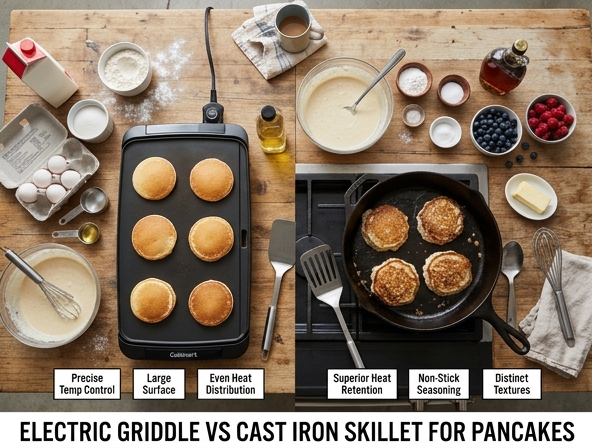
| Feature | Cast Iron Skillet | Electric Griddle |
|---|---|---|
| Heat Control | Variable; depends on stove settings | Precise and easily adjustable |
| Preparation | Requires deliberate, careful preheating | Ready for use with set temperatures |
| Primary Strength | Superior heat retention for texture | Consistency and convenience |
| Ideal Outcome | Professional-grade, golden-brown crust | Perfectly uniform pancakes |
The Great Breakfast Debate: Electric Griddle vs. Cast Iron Skillet
For many home cooks, Sunday morning is synonymous with the smell of butter, maple syrup, and the rhythmic sizzle of batter hitting a hot surface. The pancake is perhaps the most iconic breakfast staple, yet it remains a subject of intense culinary debate. While the recipe for the batter-flour, leavening, milk, and eggs-is often perfected through years of trial and error, the cooking vessel is frequently an afterthought. However, when it comes to achieving the "perfect" pancake, surface truly matters. The choice between an electric griddle and a cast iron skillet is not just about convenience; it is a choice between two entirely different philosophies of heat management, texture, and flavor.
The Case for the Electric Griddle: The King of Consistency
If you are a parent cooking for a hungry family of four or five, or if you simply value precision over ritual, the electric griddle is often the tool of choice. The primary advantage of the electric griddle is its vast, flat surface area combined with thermostatic control. Unlike traditional stovetop pans, which rely on the fluctuations of your burner, an electric griddle maintains a constant temperature dictated by the user.
- Batch Efficiency: The sheer size of an electric griddle allows you to cook six to eight pancakes simultaneously. This ensures that the first pancake and the last pancake hit the table at roughly the same time, preventing the "staggered breakfast" syndrome where the cook eats while everyone else is finished.
- Uniformity: Because the heating element is integrated directly into the surface, the heat is dispersed evenly. This eliminates the "hot spots" often found in stovetop pans, resulting in a consistent, uniform golden-brown color across the entire batch.
- Set-and-Forget Convenience: Modern electric griddles feature reliable thermostats. Once you find the "sweet spot" on the dial-usually between 350°F and 375°F-you can trust that every pancake will cook at the exact same rate.
However, the convenience comes with a trade-off. Most electric griddles rely on non-stick coatings. Over time, these coatings degrade, losing their efficacy and eventually chipping. Furthermore, the light-gauge metal typically used in these appliances lacks the "thermal mass" required to create a truly deep, caramelized crust.
The Cast Iron Skillet: The Artisan's Choice
If the electric griddle is a factory of efficiency, the cast iron skillet is an instrument of culinary soul. For those who view pancake making as an art form rather than a chore, there is no substitute for the heft and heat retention of cast iron. Cooking pancakes on cast iron is a tactile, engaged experience that yields results an electric griddle simply cannot replicate.
The Physics of the Crust: The magic of a great pancake lies in the Maillard reaction-the chemical reaction between amino acids and reducing sugars that gives browned food its distinctive flavor. Cast iron, due to its density, holds heat far more effectively than thin aluminum or coated non-stick plates. When batter hits a well-seasoned, preheated cast iron skillet, it experiences an immediate, intense sear. This creates a crisp, lacey, buttery edge that is impossible to achieve on a standard electric griddle.
- Durability: A cast iron skillet is a legacy tool. With proper care, it will outlive you. It is entirely free of chemical non-stick coatings, meaning you aren't worried about microplastics or degradation over time.
- Versatility: A cast iron skillet is not a single-tasker. When you aren't making pancakes, it's searing steaks, roasting vegetables, or baking cornbread.
- Natural Non-Stick: A well-seasoned skillet develops a "patina"-a layer of polymerized oil that acts as a natural non-stick surface. It offers a unique texture to the pancake that is savory, slightly salty, and incredibly satisfying.
Surface Matters: The Science of the "Flip"
The texture of your pancake-whether it is fluffy and cake-like or thin and crispy-edged-is entirely dependent on the interaction between the batter and the surface material. Electric griddles tend to produce "cake-like" pancakes. Because they heat up slowly and hold a consistent but moderate temperature, the pancake rises gently. The result is a pillowy, uniform crumb.
Conversely, cast iron creates a "diner-style" pancake. Because of the thermal intensity, the bottom of the pancake sets almost instantly, trapping the steam inside. This creates a distinct contrast between the crispy, golden-brown exterior and the soft, airy interior. If you are a fan of that dark, caramelized edge that tastes slightly of brown butter, cast iron is your only path to enlightenment.
Choosing Your Weapon: A Guide for the Home Cook
So, which should you choose? It comes down to your priorities:
Choose the Electric Griddle if:
- You are cooking for a large group and need to minimize time in the kitchen.
- You prefer a pillowy, uniform, cake-like pancake.
- Ease of cleanup is your primary concern (though ensure the griddle is dishwasher safe or easy to wipe down).
- You have limited patience for "watching the pan."
Choose the Cast Iron Skillet if:
- You prioritize flavor, texture, and that signature crispy edge.
- You enjoy the ritual of cooking and don't mind a slower, more deliberate process.
- You value kitchen tools that last a lifetime and avoid synthetic coatings.
- You appreciate the culinary depth that comes from a seasoned cooking surface.
Final Verdict
There is no "right" answer in the griddle-versus-skillet war; there is only the right answer for your breakfast style. The electric griddle is a master of logistics, perfect for the family cook who needs to churn out flapjacks in bulk without the headache. The cast iron skillet is a master of flavor, designed for the cook who wants every pancake to be a bespoke experience of texture and heat.
If you find yourself stuck in the middle, consider a hybrid approach. Keep the electric griddle for the weekends when the kids have friends over for sleepovers, but pull out your 10-inch cast iron skillet on a quiet Tuesday morning when you're craving a single, perfect pancake-a breakfast made for one, cooked with the care it deserves.
Regardless of your choice, remember that the surface is only half the battle. Preheat properly, butter liberally, and never flip before the bubbles appear. Happy cooking.
Disclaimer:
The information provided on Eateryn is for general educational and informational purposes only and is not intended as medical, nutritional, or healthcare advice. It should not be used to diagnose, treat, cure, or prevent any disease or medical condition.
Always consult a qualified physician, registered dietitian, or other certified healthcare professional before making changes to your diet, exercise routine, or lifestyle, or regarding any medical questions or concerns you may have. Never disregard or delay seeking professional medical advice because of something you have read on this website.