
Elbows vs Cavatappi for Macaroni and Cheese - Which Pasta Shape Holds Cheese Best
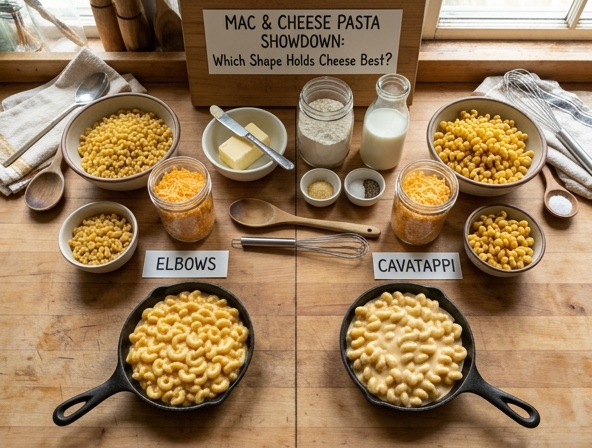
Many home cooks struggle with sauce runoff, leaving pasta bland despite a rich cheese base. While standard elbows are the traditional go-to, advanced culinary applications often favor more intricate shapes. The geometry of your pasta essentially functions as a delivery system; selecting the right one guarantees flavor-dense bites. Please note that structural surface area dictates adhesion performance. For example, cavatappi's helical ridges vastly outperform smooth elbows in sauce retention. We will now compare these mechanical advantages.
| Pasta Shape | Key Characteristics | Sauce Retention Performance |
|---|---|---|
| Elbows | Traditional, smooth surface, basic geometry | Lower; prone to sauce runoff |
| Cavatappi | Helical, ridged structure, complex surface area | Higher; superior sauce adhesion |
| Conclusion: Cavatappi acts as a better delivery system for cheese sauces due to its mechanical geometry. | ||
Elbows vs. Cavatappi: The Great Macaroni and Cheese Shape Debate
For many, macaroni and cheese is the ultimate culinary comfort. It is a dish defined by the interplay between a luscious, emulsified cheese sauce and the vessel that carries it to your palate. While the debate over béchamel versus roux-based sauces is endless, there is another, equally critical battleground: the pasta shape. In the blue corner, we have the undisputed champion of nostalgia, the humble elbow macaroni. In the red corner, we have the sophisticated, corkscrew-shaped challenger, cavatappi. To understand which holds cheese best, we must venture into the intersection of fluid dynamics, geometry, and culinary tradition.
The Elbow: The Nostalgic Standard
The elbow macaroni-the chifferi of Italian tradition-has been the gold standard for macaroni and cheese for generations. Its design is deceptively simple: a short, tubular pasta curved into a semi-circle. Its popularity is not merely a result of convenience, but of genuine engineering functionality.
The elbow's primary strength lies in its tunnel. Because the pasta is hollow, the cheese sauce doesn't just coat the outside; it infiltrates the interior. When you stir a batch of elbow-based mac and cheese, the viscosity of the sauce allows it to be captured inside the tube, creating a "cheese-filled straw" effect in every bite. This ensures that the ratio of pasta to sauce remains consistent throughout the entire bowl.
The Cavatappi: The Modern Contender
Cavatappi, which translates literally to "corkscrew," is a more complex beast. It is essentially a long, tubular pasta that has been twisted into a spiral. Along the exterior of these spirals, manufacturers often add ridges, known as rigate. This design is built for heavy-duty sauce delivery.
If the elbow is a standard straw, the cavatappi is a deep-threaded screw. The ridges on the outside of the cavatappi provide significant surface area for the cheese sauce to cling to, while the internal spiral creates a winding tunnel that traps even thicker, heartier sauce blends. It provides a more robust "bite," offering a textural contrast that the thinner, softer elbow often lacks.
The Science of "Cling" and Viscosity
When we ask which shape "holds" cheese best, we are really asking about surface tension and viscosity. A cheese sauce, typically made of melted cheddar, gruyère, or a mornay base, is a non-Newtonian fluid that thickens as it cools.
- Adhesion: The ridges on the cavatappi increase the surface area significantly compared to the smooth exterior of a standard elbow. This allows more cheese to coat the exterior of the pasta, ensuring that every forkful is coated in a uniform layer.
- Entrapment: The internal cavity of the elbow is excellent for thinner sauces, but the cavatappi's larger, winding interior is better suited for chunkier additions-like breadcrumbs, bacon bits, or bits of caramelized onion-to get caught in the pasta itself.
The "Baked" Factor
The debate changes significantly depending on whether you are making stovetop mac and cheese or a baked casserole. In a baked dish, the pasta undergoes a second round of heat treatment in the oven. Elbows have a tendency to soften significantly during this process, sometimes losing their structural integrity and becoming "mushy" if overcooked.
Cavatappi, due to its heavier construction and spiral geometry, holds up far better under the stress of oven temperatures. The structural integrity of the corkscrew shape prevents it from collapsing under the weight of the cheese sauce and the crispy topping. If your goal is a baked macaroni and cheese with a distinct, toothsome pasta texture, cavatappi is objectively superior.
The Verdict: Which Should You Choose?
There is no "wrong" choice, but there is a "better" choice depending on your intended experience:
Choose Elbows If:
- You are chasing the nostalgic, childhood experience of a quick, stove-top meal.
- Your sauce is on the thinner side (perhaps a classic American cheese melt).
- You are feeding children who prefer a smaller, more manageable bite-sized pasta.
Choose Cavatappi If:
- You are preparing a gourmet, baked macaroni and cheese for a dinner party.
- You are using a heavy, complex cheese blend or adding mix-ins like peas, mushrooms, or pancetta.
- You want a dish with sophisticated texture and a more "professional" presentation.
Conclusion
While the elbow macaroni will always hold a place in our hearts-and our pantries-the cavatappi represents an evolution in the art of the casserole. If "holding the cheese" is the primary metric, the cavatappi wins by a landslide due to its increased surface area and robust, multi-dimensional geometry. It captures the sauce both externally and internally with a level of precision that the simple elbow cannot match.
Ultimately, the best pasta shape is the one that brings you the most joy. Whether you prefer the classic comfort of the curved elbow or the architectural brilliance of the cavatappi, the secret to a great mac and cheese will always lie in the quality of the dairy, the care of the roux, and the passion with which you stir the pot.
Disclaimer:
The information provided on Eateryn is for general educational and informational purposes only and is not intended as medical, nutritional, or healthcare advice. It should not be used to diagnose, treat, cure, or prevent any disease or medical condition.
Always consult a qualified physician, registered dietitian, or other certified healthcare professional before making changes to your diet, exercise routine, or lifestyle, or regarding any medical questions or concerns you may have. Never disregard or delay seeking professional medical advice because of something you have read on this website.