
Double Fry vs Single Fry for Fried Chicken - Mastering Professional Crunch
Mastering the Professional Crunch
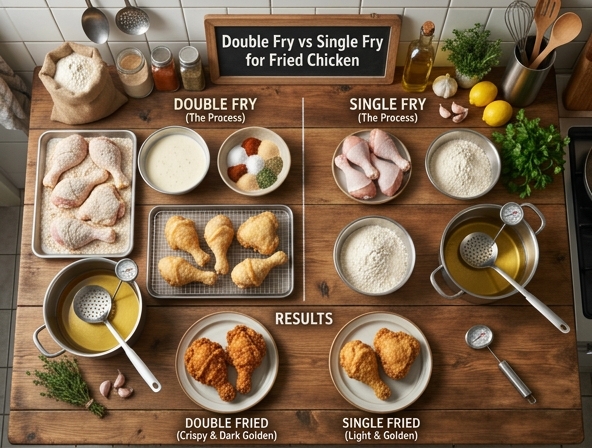
Many chefs struggle with inconsistent, greasy crusts that lose their texture shortly after service. While single-fry techniques and oven-baked alternatives are industry standards, they rarely yield a truly professional, shatter-crisp finish. Adopting a precise double-fry method guarantees a superior, stable crust. Success, however, demands strict adherence to temperature-controlled oil recovery. High-end kitchens consistently utilize this dual-stage process to achieve perfection. This guide examines the thermodynamic advantages and specific mechanics required to elevate your fried chicken program.
| Aspect | Key Summary Details |
|---|---|
| Core Goal | Achieving a professional, "shatter-crisp" crust on fried chicken. |
| The Problem | Single-fry and oven-baked methods often result in greasy, inconsistent textures that degrade quickly. |
| The Solution | Implementing a precise dual-stage (double-fry) cooking process. |
| Critical Factor | Strict adherence to temperature-controlled oil recovery between frying stages. |
| Industry Standard | High-end kitchens utilize this method to ensure crust stability and superior quality. |
Double Fry vs Single Fry for Fried Chicken: Mastering Professional Crunch
To the uninitiated, fried chicken is a simple affair: bread it, drop it in hot oil, and serve. But to the culinary perfectionist, fried chicken is a complex architectural project. The holy grail of the craft is the "professional crunch"-that distinct, glass-like shatter that greets the teeth before yielding to succulent, steaming meat. The debate between the single-fry and the double-fry methods is where the amateur diverges from the master.
The Single Fry: The Convenient Classic
The single-fry method is the standard approach in most home kitchens. You heat your oil to a stable 350°F (175°C), submerge your battered chicken, and cook it until it is golden brown and the internal temperature reaches 165°F (74°C). While this method is undeniably faster and more convenient, it frequently leaves something to be desired. The primary issue with the single-fry approach is a phenomenon known as "structural degradation."
When you fry chicken only once, the crust and the meat are cooked simultaneously. As the moisture from the chicken tries to escape, it is forced through the batter, often softening it from the inside out. Furthermore, because the chicken needs time to cook through to the bone, the exterior is often exposed to the heat for too long, leading to a crust that is either unevenly browned, prone to burning, or overly saturated with oil. The result is often a "greasy" crunch rather than a "shattering" one.
The Double-Fry Advantage: A Study in Science
The double-fry technique, popularized by Korean fried chicken artisans and practiced by high-end gastropubs, treats the cooking of the chicken as a two-phase process: moisture removal and surface crystallization.
Phase 1: The Par-Fry (Low and Slow)
In the double-fry method, the first fry occurs at a lower temperature, typically around 300°F–325°F (150°C–160°C). The goal here is not to achieve the final color, but to gently cook the meat and set the batter structure without aggressively browning the exterior. By cooking at a lower temperature, you allow the heat to penetrate the chicken evenly. The moisture trapped within the batter begins to steam out, creating a rigid, "blank" canvas for the second fry.
Phase 2: The Final Crisp (High and Fast)
After the first fry, the chicken is removed and allowed to rest. This rest period is critical-it allows the residual heat to finish cooking the meat and enables the crust to cool slightly, which helps trapped moisture migrate toward the surface. The second fry happens at a higher temperature, between 375°F and 390°F (190°C–200°C). This rapid, high-heat blast serves only one purpose: to dehydrate the surface of the batter instantly and caramelize the starch molecules. Because the chicken is already cooked, it only needs to be in the oil for a minute or two. The result is a thin, impossibly crispy shell that acts as a moisture barrier, keeping the meat juicy while staying crunchy for an extended period.
The Technical Nuances: Why It Matters
Understanding the chemistry of the double fry changes how you view oil management. In a single fry, the oil temperature drops drastically when cold chicken hits the pot, and the long recovery time often leads to a "soggy" crust because the chicken is essentially poaching in oil rather than frying in it.
By splitting the process, you gain better control over your oil. You are not asking your oil to do two impossible things at once-cook through the deep, dense protein and crisp the delicate, airy exterior. You are compartmentalizing the thermal energy, leading to several measurable benefits:
- Reduced Oil Absorption: The rapid second fry forces moisture out so violently that the oil is prevented from soaking into the breading.
- Structural Integrity: The crust becomes a reinforced matrix, ensuring it doesn't fall off the chicken the moment you take a bite.
- Visual Consistency: You achieve that perfect, deep mahogany or golden-bronze color without the risk of overcooking the meat.
Pro Tips for the Ultimate Result
If you want to master the double fry, focus on these three pillars of success:
- The Rest Period: Do not skip the resting time between fries. If the chicken is too hot or humid from the first fry, the second fry will not reach its maximum potential. Let the chicken sit for at least 10–15 minutes.
- Oil Selection: Use an oil with a high smoke point, such as peanut oil, avocado oil, or refined high-oleic sunflower oil. Given the high-temperature second fry, you need an oil that won't break down or impart bitter, burnt flavors.
- Don't Overcrowd: Whether single or double frying, overcrowding the pot is the enemy of crispiness. Keep the oil temperature consistent by frying in batches. If the temperature drops below your target, the batter will turn into a sponge.
The Verdict
Is the double fry more work? Absolutely. It requires more time, more patience, and more management of the stovetop. However, if you are chasing that professional, "sonic" crunch-the kind that makes you close your eyes and savor the bite-there is simply no substitute. The single fry is for Tuesday night convenience; the double fry is for culinary excellence. Once you have tasted the structural perfection of a double-fried wing or thigh, you will find it nearly impossible to go back to the singular, sluggish method. Mastering the dual-stage technique is the definitive step toward turning your home kitchen into a professional-grade fry station.
Disclaimer:
The information provided on Eateryn is for general educational and informational purposes only and is not intended as medical, nutritional, or healthcare advice. It should not be used to diagnose, treat, cure, or prevent any disease or medical condition.
Always consult a qualified physician, registered dietitian, or other certified healthcare professional before making changes to your diet, exercise routine, or lifestyle, or regarding any medical questions or concerns you may have. Never disregard or delay seeking professional medical advice because of something you have read on this website.