
Double Fried Vs Single Fried For Buffalo Wings - Creating The Professional Restaurant Texture
Achieving a signature, shatter-crisp restaurant finish often eludes home cooks, resulting in soggy or greasy wings. While single-frying is the common domestic standard, professional kitchens favor a refined dual-stage approach. Double frying is the essential value-add, ensuring succulent interiors encased in an impenetrable, glass-like crust. Note that success requires strict temperature management to avoid excess oil absorption. This methodology delivers the superior texture found in top-tier gastropubs. Below, we examine the thermodynamic science behind this technique.
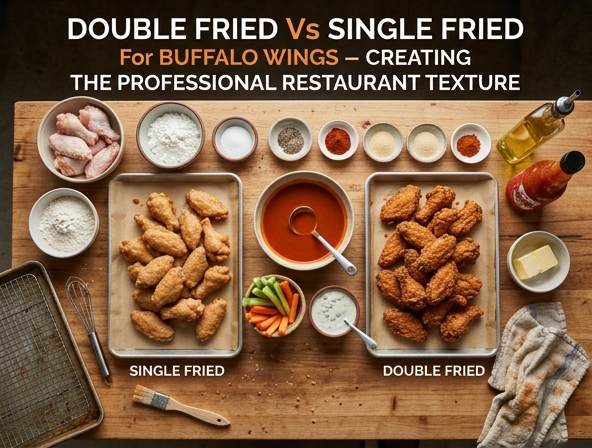
| Feature | Single Frying | Double Frying |
|---|---|---|
| Application | Common home domestic standard | Professional restaurant technique |
| Resulting Texture | Often soggy or greasy | Succulent interior with a glass-like, shatter-crisp crust |
| Execution Level | Simple/Basic | Refined dual-stage process |
| Note: Proper temperature management is essential in both methods to prevent excessive oil absorption. | ||
Double Fried Vs Single Fried For Buffalo Wings: Creating The Professional Restaurant Texture
For the home cook, the pursuit of the perfect Buffalo wing is often a journey of trial and error. We crave that elusive, "shatter-crisp" skin that holds up against a deluge of vinegary, buttery hot sauce without turning into a soggy mess. While the quality of the chicken and the balance of the sauce matter, the true secret to restaurant-quality wings lies entirely in the physics of the fry. The debate between single-frying and double-frying is essentially a debate between convenience and chemistry. If you want wings that rival those from top-tier sports bars or dedicated wing joints, the double-fry method isn't just a suggestion-it is a requirement.
The Physics of the Fry: Why Single Frying Falls Short
To understand why double-frying is superior, we must first look at what happens to a chicken wing in hot oil. A chicken wing is composed of three things: muscle, fat, and skin. The skin, when properly prepared, is a thin layer of collagen and fat. When you drop a wing into a deep fryer, two processes happen simultaneously: the internal meat cooks, and the moisture on the surface of the skin evaporates, allowing the fat to render and crisp.
In a single-fry approach, the cook is fighting a losing battle. If you fry the wing at a high enough temperature to get the skin perfectly crispy, the internal meat will often overcook and become stringy or dry. If you fry it at a lower temperature to keep the meat succulent, the skin will remain flabby or oil-logged because the moisture couldn't evaporate fast enough. This is the "single-fry compromise"-you end up with a wing that is either tender but soggy, or crispy but overcooked.
The Double-Fry Strategy: The Professional Blueprint
The professional restaurant technique solves this conflict by splitting the cooking process into two distinct phases, each serving a specific purpose. This is a technique famously utilized in high-end culinary circles, from Korean fried chicken specialists to legendary Buffalo wing taverns.
Phase 1: The Low-Temperature Poach
The first fry occurs at a lower temperature, typically around 250°F to 275°F (120°C to 135°C). At this stage, you aren't trying to achieve color; you are essentially poaching the wing in fat. This lower heat gently cooks the meat through to the bone while slowly rendering out the fat trapped beneath the skin. During this phase, you are also dehydrating the surface of the skin. Because the temperature is low, the moisture evaporates steadily without burning the proteins, ensuring the meat remains juicy and tender.
Phase 2: The High-Temperature Crisp
Once the wings have been poached through, they are removed from the oil and allowed to rest. This resting period is critical; it allows the wings to cool down and allows the surface moisture to dissipate further. The final stage is a quick, high-heat fry, usually around 375°F to 400°F (190°C to 205°C). When the wing hits this intense heat, the already-rendered fat bubbles violently, and the skin dehydrates almost instantly. This triggers the Maillard reaction, resulting in a dark golden-brown, glass-like crust that is remarkably durable.
The Execution: A Step-by-Step Guide
Achieving this texture at home requires patience, but the steps are straightforward. Follow this workflow to replicate the professional standard:
- Pre-Fry Prep: Dry your wings thoroughly with paper towels. Excess surface moisture is the enemy of crispiness. Some professionals even toss the wings in a light dusting of cornstarch or baking powder (not baking soda) to further draw out moisture, though this is optional if your double-fry technique is sound.
- The First Fry: Heat your oil to 250°F. Fry the wings for 8 to 10 minutes. They will look pale and unappealing-do not be tempted to keep them in longer. Remove them and set them on a wire rack. Let them rest for at least 15 to 20 minutes. You can even refrigerate them at this point if you are prepping for a party.
- The Second Fry: Crank the heat to 375°F. Drop the rested wings back into the oil. Watch them closely; this stage only takes 3 to 5 minutes. You are looking for a deep golden hue and a skin that sounds hard if you tap it with tongs.
- The Toss: Remove the wings and immediately toss them in your sauce. Because the skin is so dehydrated and crispy, it will absorb the flavors of the sauce without losing its structural integrity.
Why Temperature Control is Non-Negotiable
The most common mistake home cooks make is failing to regulate oil temperature. When you add cold wings to hot oil, the temperature drops rapidly. If you don't have a high-BTU professional burner, you must fry in smaller batches to prevent the oil temperature from crashing. A digital thermometer is your best friend here. If your oil dips below 225°F during the first fry, the wings will absorb too much grease. If it rises above 400°F during the second, the skin will turn bitter and dark before the texture is properly set.
The Final Verdict: Efficiency vs. Excellence
The single-fry method is undeniably faster, but the double-fry method offers a superior culinary experience. By decoupling the cooking of the meat from the crisping of the skin, you eliminate the compromises that plague home-cooked wings. A double-fried wing maintains its crunch for much longer, even when submerged in a heavy buffalo or garlic parmesan sauce.
When you serve a double-fried wing, you aren't just serving a snack-you are serving a masterclass in texture. The contrast between the shattered crust and the succulent, flavorful meat underneath is the hallmark of a professional dish. Once you taste the difference that a double fry makes, you will find it nearly impossible to go back to the singular, mediocre fry.
Disclaimer:
The information provided on Eateryn is for general educational and informational purposes only and is not intended as medical, nutritional, or healthcare advice. It should not be used to diagnose, treat, cure, or prevent any disease or medical condition.
Always consult a qualified physician, registered dietitian, or other certified healthcare professional before making changes to your diet, exercise routine, or lifestyle, or regarding any medical questions or concerns you may have. Never disregard or delay seeking professional medical advice because of something you have read on this website.