
Deep Dish vs Standard for Apple Pie - Calculating the Ratio of Fruit to Crust
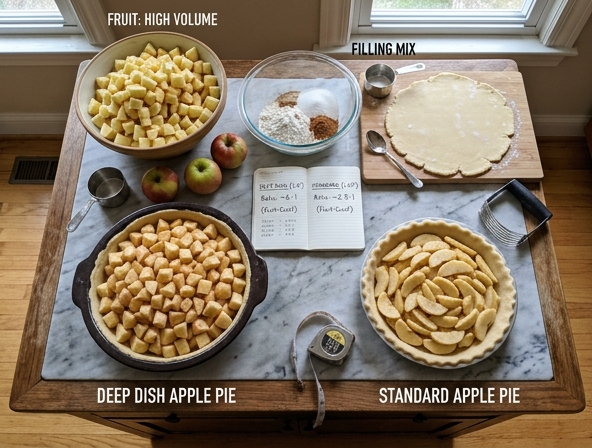
Achieving a balanced apple pie is notoriously difficult, as bakers often struggle with soggy bottoms or structural collapse. While standard recipes favor shallow plates, they rarely account for the physics of heat distribution. Mastering the precise fruit-to-crust ratio is the defining variable for a professional finish. Note that fruit hydration levels will inevitably fluctuate. For instance, high-moisture Granny Smiths require a calculated 3:1 filling-to-crust volume. The following analysis outlines optimal ratios for both deep-dish and standard formats.
| Aspect | Details |
|---|---|
| Core Challenges | Soggy bottoms, structural collapse, and uneven heat distribution. |
| Defining Variable | Precise fruit-to-crust volume ratio based on fruit hydration levels. |
| Recommended Ratio | 3:1 (Filling-to-Crust) for high-moisture fruit varieties (e.g., Granny Smith). |
| Strategic Goal | Achieving a professional finish by balancing physics and recipe volume. |
Deep Dish vs. Standard Apple Pie: Calculating the Ratio of Fruit to Crust
For the home baker, the humble apple pie is an exercise in culinary architecture. While the ingredients-apples, sugar, butter, flour, and spices-remain constant, the structural delivery system (the pan) changes the experience entirely. The debate between a standard nine-inch pie plate and a deep-dish vessel is not merely aesthetic; it is a mathematical calculation that dictates the sensory profile of every bite. At its core, this choice is an exploration of the ratio of fruit to crust, a variable that defines the balance between structural integrity and textural delight.
The Geometry of the Pie: Standard vs. Deep Dish
To understand the difference, we must first look at the geometry. A standard American pie plate is typically nine inches in diameter with a depth of approximately 1.5 to 2 inches. A deep-dish pie, often baked in a springform pan or a specialized deep-pie dish, can reach depths of 3 to 4 inches. This difference in volume significantly alters the fruit-to-crust ratio.
In a standard pie, the surface area of the crust-both top and bottom-is disproportionately high relative to the volume of the filling. This results in a "crust-forward" experience. Every bite is designed to balance the crunch of the pastry with the softened fruit within. Conversely, the deep-dish pie minimizes the crust-to-filling ratio. Here, the fruit is the protagonist, and the crust acts primarily as a structural container and a textural contrast rather than a dominant flavor component.
Calculating the Ratio: The Mathematics of Moisture
When calculating the ideal ratio, we must consider the volumetric capacity. A standard pie holds approximately 4 to 5 cups of sliced apples. A deep-dish pie can easily house 8 to 10 cups. However, volume is only one part of the equation; evaporation is the other.
Because the standard pie has a high surface-area-to-volume ratio, the moisture from the apples evaporates more efficiently through the steam vents in the top crust. This creates a denser, more concentrated flavor profile. In the deep-dish pie, the sheer mass of fruit creates a "stewing" effect. The fruit at the bottom of the pan is subjected to the weight of the fruit above it, often resulting in a softer, more compote-like consistency. This requires a slight adjustment in your thickener (flour, cornstarch, or tapioca) to ensure that the increased volume of juice doesn't lead to a "soggy bottom" scenario.
The Physics of the Crust
The crust in a standard pie is subjected to heat from both the bottom and the top simultaneously. Because the pie is thinner, the heat penetrates to the center of the fruit filling faster, allowing the crust to brown and crisp before the apples turn to mush. This is the hallmark of the traditional "American-style" pie: a balance of flaky, buttery pastry and tender, but still structural, apple slices.
In a deep-dish model, the physics become more complex. Because the filling is deeper, it takes longer for the center to reach the boiling point of the pectin, which is necessary for the filling to set. This leaves the crust vulnerable to over-browning or burning. Bakers often have to rely on "shielding" the edges with foil or lowering the oven temperature for the second half of the bake to ensure the fruit cooks through without the pastry becoming burnt. The resulting crust in a deep-dish pie is often relegated to the edges and the top, meaning there is less pastry per mouthful compared to a standard pie.
Which Ratio is "Correct"?
The determination of the "correct" ratio depends entirely on the intended eating experience:
- The Standard Ratio (The Balanced Experience): If you are a fan of the interplay between buttery, flaky crust and fruit, the standard 9-inch plate is superior. It ensures that the crust never gets lost, and the thickness allows for a cleaner slice. This is the ideal format for pies served with a scoop of ice cream, as the crust provides a necessary "shelf" to hold the melting dairy.
- The Deep Dish Ratio (The Fruit-Centric Experience): If you are an apple purist who believes the pastry is merely a vessel for the fruit, the deep-dish is the clear winner. The significantly higher ratio of filling to crust allows for a richer, more concentrated apple flavor. It is, in essence, closer to an apple cobbler or a Dutch oven fruit bake than a traditional pie.
Optimizing Your Bake
If you choose to venture into the deep-dish realm, you must account for the structural load. A deep-dish pie has a much higher potential for leaking juices. Always place the pie on a heavy-duty baking sheet to catch any bubbling sugar, and consider increasing your starch content by roughly 20-30% compared to a standard recipe to compensate for the extra juice released by the additional volume of fruit.
Conversely, if you stick with the standard pie, focus on the crust's quality. Since the crust-to-fruit ratio is higher, you have more surface area to impress your guests. Use high-fat butter, consider a hint of coarse sugar on the top crust, and ensure your venting is adequate to allow that moisture to escape, keeping the ratio of "crisp" to "soft" perfectly aligned.
Final Thoughts
The debate between deep dish and standard apple pie is a testament to how small changes in volume can dictate the final character of a dish. Whether you prefer the balanced, pastry-heavy crunch of a standard 9-inch pie or the jammy, fruit-forward intensity of a deep-dish creation, the science remains the same: it is all about managing the moisture, the heat, and the geometry of the plate. Next time you reach for your pie dish, consider not just how much fruit you can fit, but what kind of eating experience you want to create.
Disclaimer:
The information provided on Eateryn is for general educational and informational purposes only and is not intended as medical, nutritional, or healthcare advice. It should not be used to diagnose, treat, cure, or prevent any disease or medical condition.
Always consult a qualified physician, registered dietitian, or other certified healthcare professional before making changes to your diet, exercise routine, or lifestyle, or regarding any medical questions or concerns you may have. Never disregard or delay seeking professional medical advice because of something you have read on this website.