
Cracker Crumbs vs Panko For Meatloaf - Mastering The Texture And Crunch
Cracker Crumbs vs Panko For Meatloaf: Mastering The Texture And Crunch
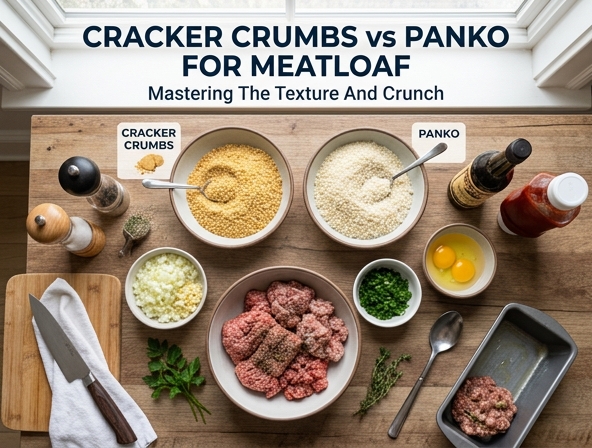
Achieving the ideal meatloaf texture remains a consistent challenge for many home cooks. While traditional breadcrumbs serve as the standard binding agent, selecting the right base-such as fine saltine crumbs versus airy Japanese panko-grants your dish superior structural integrity and bite. It is important to note that performance varies by moisture content and fat ratio. This guide evaluates how these distinct binders influence density and crust, ultimately determining which profile best suits your culinary objectives.
| Feature | Cracker Crumbs (Saltine) | Panko (Japanese) |
|---|---|---|
| Texture Influence | Dense and compact | Airy and light |
| Primary Benefit | Superior structural integrity | Enhanced crunch and mouthfeel |
| Binding Performance | High; acts as a strong binder | Lower; best for light structure |
| Best For | Classic, firm-slice meatloaf | Meatloaf with a crispy outer crust |
| Note: Performance is also influenced by the specific moisture content and fat ratio of your meat mixture. | ||
Cracker Crumbs vs. Panko For Meatloaf: Mastering The Texture And Crunch
Meatloaf is arguably the cornerstone of comfort food. It is a dish that relies on simplicity, yet it is notoriously easy to get wrong. You've likely experienced the two extremes of a failed meatloaf: the "brick"-a dense, rubbery slab that feels like it's fighting back-and the "mush"-a loose, uninspired heap that disintegrates the moment it meets a fork. The secret to finding the middle ground between these two extremes lies in your choice of binder, specifically the breadcrumb component.
While generations of home cooks have sworn by crushed saltines or Ritz crackers, the rise of Japanese panko has introduced a new contender into the kitchen. Both ingredients serve the same fundamental purpose-absorbing moisture and fat to provide structural integrity-but they perform these tasks in vastly different ways. Understanding the science behind these binders is the first step toward mastering the perfect meatloaf.
The Essential Science: Why We Need A Binder
Before diving into the choice between crackers and panko, it is important to understand why breadcrumbs are necessary at all. Ground meat, when cooked, tends to tighten and contract. As the proteins coagulate, they squeeze out moisture. Without a binder, a meatloaf would be a shrunken, dry lump of protein. Breadcrumbs act as a sponge, holding onto the juices (and the flavorful fat rendered from the meat) throughout the cooking process. They also physically disrupt the meat protein strands, preventing the loaf from becoming too dense. Essentially, the breadcrumbs are the structural scaffolding that keeps your meatloaf tender and juicy.
The Case for Cracker Crumbs: The Nostalgic Classic
If you grew up eating meatloaf made by your grandmother, the chances are high that she reached for a sleeve of saltines or butter crackers. Cracker crumbs provide a very specific sensory experience. Because they are typically made from refined wheat flour and contain added fat and salt, they integrate into the meat mixture differently than bread-based crumbs.
The Texture Profile
Cracker crumbs are finely milled, meaning they absorb moisture quickly and turn into a paste-like consistency when mixed with milk or eggs. This creates a highly uniform, dense meatloaf. If your preference is for a sliceable, "deli-style" meatloaf that holds its shape perfectly even when cold, crackers are your best friend. The resulting texture is firm and rich, providing a satisfying "chew" that many associate with traditional American cooking.
The Flavor Factor
Crackers are seasoned. Saltines add a hit of salinity, while buttery crackers like Ritz introduce a subtle richness and a hint of sweetness. This adds a layer of depth to the meatloaf that doesn't require as much external seasoning. However, be warned: if you rely on crackers, you must be careful not to over-salt your meat mixture, as the crackers will do a significant portion of the work for you.
The Case for Panko: The Modern, Airy Alternative
Panko, the Japanese-style breadcrumb, has become the darling of modern kitchens for good reason. Unlike traditional breadcrumbs or cracker dust, panko is made from crustless white bread that has been processed into large, flaky shards rather than fine granules. These shards are then dried at a low temperature, keeping them light and airy.
The Texture Profile
The primary advantage of panko is its resistance to turning into mush. Because the flakes are larger and have a higher surface area, they absorb moisture without losing their structure. In a meatloaf, this translates to an incredibly tender, light loaf that feels "fluffy" on the palate rather than dense. If you find standard meatloaf to be too heavy or uniform, panko is the solution. It leaves the meatloaf feeling like a collection of seasoned morsels held together by a delicate web, rather than a solid block of protein.
The Moisture Retention
Panko acts like a reservoir. Because of its irregular shape, it traps tiny pockets of air and moisture within the meat mixture. This means that even after an hour in a hot oven, the interior of the meatloaf remains remarkably hydrated. Panko-based loaves are almost impossible to dry out, making them a fantastic choice for leaner ground meats like turkey or chicken.
The "Panade" Technique: The Professional's Secret
Regardless of whether you choose crackers or panko, the real secret to texture isn't just the crumb-it's the panade. A panade is the mixture of your breadcrumbs and a liquid (typically milk, buttermilk, or even beef stock) before it is combined with the meat.
By soaking your crumbs in liquid for 5–10 minutes before adding them to the ground beef, you ensure that the crumbs are fully hydrated. If you simply throw dry crumbs into the meat, they will compete with the meat proteins for moisture during the cooking process, often leaving the meat dry. By pre-hydrating, you ensure that the "scaffolding" is already soft and ready to hold the flavor-packed juices that the meat will release during cooking.
Choosing Your Champion: A Decision Guide
- Choose Cracker Crumbs If: You are aiming for a classic, tight-textured meatloaf that slices easily. You enjoy a slightly saltier, more savory profile, and you are preparing a traditional meal where "meatiness" is the primary goal.
- Choose Panko If: You want a light, tender, and moist meatloaf. You are looking to incorporate extra moisture (like sauteed onions or grated vegetables) into your meatloaf without it becoming soggy, or you are using leaner meats that benefit from a lighter binder.
Final Tips for Success
Don't be afraid to experiment with ratios. A common mistake is using too much binder. A good rule of thumb is 1 cup of crumbs (or panko) for every 2 pounds of meat. Any more than that, and you are moving into the realm of "bread loaf with a hint of meat."
Finally, remember the importance of temperature. Whether using crackers or panko, the meatloaf should always rest for at least 15 minutes after exiting the oven. During this time, the internal juices redistribute throughout the crumbs. If you cut into the loaf too early, all that hard-earned moisture will run out onto the cutting board, regardless of which binder you chose.
Mastering meatloaf is a journey, not a destination. Whether you stay loyal to the cracker-crushed traditions of the past or embrace the airy, flaky benefits of modern panko, the most important ingredient remains your attention to the balance between moisture, binder, and heat. Start with these guidelines, tweak your ratios, and find the texture that makes your dinner table feel like home.
Disclaimer:
The information provided on Eateryn is for general educational and informational purposes only and is not intended as medical, nutritional, or healthcare advice. It should not be used to diagnose, treat, cure, or prevent any disease or medical condition.
Always consult a qualified physician, registered dietitian, or other certified healthcare professional before making changes to your diet, exercise routine, or lifestyle, or regarding any medical questions or concerns you may have. Never disregard or delay seeking professional medical advice because of something you have read on this website.