
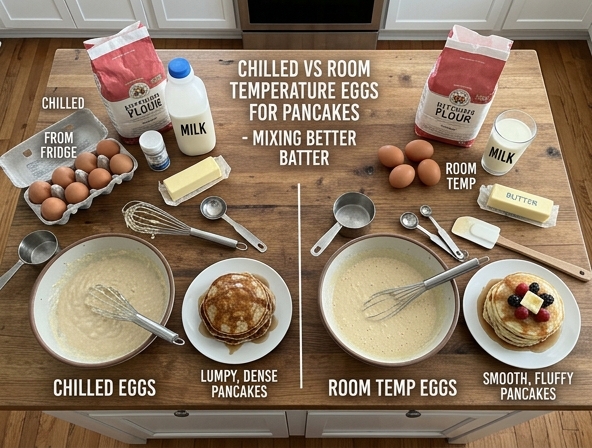
Chilled vs Room Temperature Eggs for Pancakes - Mixing Better Batter
Ever struggle with lumpy, uneven pancake batter despite vigorous whisking? Home cooks often grab eggs directly from the refrigerator, following standard grocery storage protocols. However, mastering egg temperature is the true catalyst for a superior, emulsified batter. Note that while temperature helps, proper technique is essential; cold eggs often shock fats into premature solidification. Professional kitchens, like those in high-end bakeries, prioritize room-temperature ingredients for optimal structural integrity. This guide explores the science behind temperature's impact on batter consistency.
| Concept | Details |
|---|---|
| The Common Issue | Lumpy and uneven pancake batter caused by improper ingredient preparation. |
| The Mistake | Using eggs directly from the refrigerator, which can shock fats into solidifying. |
| The Solution | Bringing eggs to room temperature before mixing to ensure proper emulsification. |
| The Benefit | Achieving better structural integrity and a smoother, more consistent batter. |
| Key Takeaway | While professional-grade ingredients are important, combining room-temperature eggs with proper mixing technique is the secret to perfect pancakes. |
The Great Pancake Debate: Why Egg Temperature Actually Matters for Your Batter
Every weekend, millions of kitchens across the globe transform into short-order diners. The sizzle of butter, the sweet aroma of maple syrup, and the rhythmic flip of a spatula define the quintessential Saturday morning. Yet, despite the simplicity of pancakes, home cooks often find themselves baffled by inconsistencies in their final product. Sometimes the pancakes are light and airy; other times, they are dense, slightly rubbery, or inconsistently cooked. While the blame often falls on the baking powder or the flour, there is a silent culprit lurking in the refrigerator: the humble egg.
The Science of Emulsification: Why Temperature Matters
To understand why egg temperature matters, we have to look at the chemistry of the pancake batter. At its core, a pancake batter is an emulsion-a delicate suspension of fats (the butter or oil) and water-based ingredients (milk, eggs). When you combine these, you are asking oil and water to coexist in harmony.
When you use chilled eggs straight from the refrigerator, you are introducing a cold mass into your liquid mixture. If your recipe calls for melted butter-a common ingredient in pancake recipes-the cold egg will immediately cause the fat to solidify upon contact. This creates tiny, hardened globules of butter rather than a smooth, uniform distribution of fat throughout the batter. This lack of emulsification means that your pancakes will not cook evenly; some parts of the pancake may be oily, while others lack the tenderizing effect that fat provides, leading to a chewy or tough texture.
Volume, Elasticity, and the Rise
Beyond the fat distribution, temperature plays a critical role in how the proteins within the egg behave. Egg whites consist of proteins that are tightly coiled when cold. As the temperature rises, these protein structures become more flexible and elastic.
When you whisk eggs into your batter, you are incorporating air. Eggs that are at room temperature are far more efficient at trapping this air. Because the proteins are more relaxed, they can stretch further, creating a finer, more stable foam. When these air bubbles encounter the heat of your skillet, they expand more reliably, contributing to the "lift" of your pancake. If your eggs are ice-cold, the batter is essentially heavier and less capable of holding onto that precious aeration, resulting in a flatter, denser flapjack.
The "Cold Egg" Conundrum: Why Convenience Often Wins
Many home cooks stick to chilled eggs for two primary reasons: convenience and safety. We are conditioned to keep eggs in the refrigerator, and the idea of letting them sit out feels like an extra step that disrupts the flow of a quick breakfast. Furthermore, there is a persistent, albeit largely misunderstood, fear regarding food safety. While raw eggs can carry risks, the reality is that for short-term preparation-letting them sit out for 20 to 30 minutes-the risk of bacterial growth is negligible.
However, the impact on the batter is tangible. When you use cold eggs, you are essentially "shocking" your ingredients. If you are using a recipe that relies on buttermilk or sour cream, which are often also cold, you are creating a batter that is significantly colder than room temperature. This slows down the activation of your leavening agents (baking powder or baking soda), which typically require a bit of warmth to kickstart their chemical reaction before the pancake hits the pan.
Practical Tips: The Quick-Warm Method
If you find yourself ready to cook but realize your eggs are still in the fridge, don't despair. You don't need to wait for hours to get them to room temperature. The "warm water bath" method is the industry secret for chefs and bakers alike.
- Step 1: Fill a small bowl with warm (not hot) tap water.
- Step 2: Submerge your whole, uncracked eggs in the water.
- Step 3: Let them sit for 5 to 10 minutes.
- Step 4: Dry them off, crack them into your bowl, and proceed with your recipe.
This simple trick brings the eggs to an ambient temperature without compromising the integrity of the shell or the interior contents. It ensures that when the eggs meet the melted butter and the flour, everything is at a similar temperature, leading to a smooth, cohesive batter that is ready to perform.
The Verdict: Does It Really Make a Difference?
If you are making basic, utilitarian pancakes for a hungry crowd, will the world end if you use cold eggs? Of course not. You will still have breakfast. However, if you are looking to elevate your cooking from "passable" to "extraordinary," the temperature of your ingredients is one of the "marginal gains" that distinguish professional results from average home cooking.
The texture of a pancake made with room-temperature eggs is noticeably more uniform. You will see fewer lumps of fat, a more consistent browning on the exterior, and a fluffier, more pillowy interior crumb. It is the difference between a pancake that is merely a vehicle for syrup and one that stands as a culinary achievement in its own right.
Conclusion: The Intentional Cook
Great cooking is often about attention to detail. By consciously deciding to bring your eggs to room temperature, you are acknowledging the science behind the food you prepare. It is a small, quiet act of culinary mindfulness. Next time you prepare for a pancake breakfast, set your eggs out on the counter while you measure your dry ingredients. Give them the time to warm up. Your batter will thank you with a smoother texture, and your final, golden-brown pancakes will reward you with a lighter, more satisfying bite. It turns out, the secret to a better pancake isn't in a fancy ingredient or a secret spice-it's simply in the temperature.
Disclaimer:
The information provided on Eateryn is for general educational and informational purposes only and is not intended as medical, nutritional, or healthcare advice. It should not be used to diagnose, treat, cure, or prevent any disease or medical condition.
Always consult a qualified physician, registered dietitian, or other certified healthcare professional before making changes to your diet, exercise routine, or lifestyle, or regarding any medical questions or concerns you may have. Never disregard or delay seeking professional medical advice because of something you have read on this website.