
Chicago vs New York for Hot Dog - Regional Style Comparison
Choosing between a Chicago and New York hot dog often feels like a culinary impasse. While traditionalist critics frequently rely on local hearsay, an objective evaluation requires a deeper framework. We offer a structured analysis of these regional titans to refine your palate. Please note, this comparison focuses strictly on classic regional benchmarks, such as Chicago's poppy seed bun versus New York's signature snap and sauerkraut. This guide will clarify the technical distinctions defining these icons.
| Feature | Chicago Style | New York Style |
|---|---|---|
| Bun | Poppy seed bun | Standard bun |
| Key Characteristic | Strict regional adherence | Signature "snap" |
| Defining Topping | Regional specified ingredients | Sauerkraut |
The Great American Frank: A Tale of Two Cities
In the pantheon of American street food, few items command as much reverence, debate, and regional pride as the hot dog. While the humble frankfurter exists in every corner of the United States-from the bacon-wrapped delights of Los Angeles to the slaw-topped creations of the South-the rivalry between Chicago and New York stands as the true heavyweight championship of the genre. To eat a hot dog in Chicago is a culinary undertaking; to eat one in New York is a rite of passage. But what separates these two styles, and why do they hold such a fierce grip on their respective regional identities?
The Chicago Style: Dragged Through the Garden
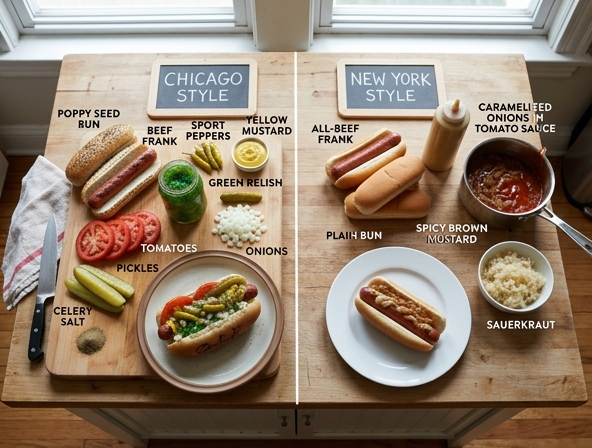
In Chicago, the hot dog is not merely a quick snack; it is a meticulously constructed architecture of flavor. The Chicago-style hot dog is governed by a strict, almost theological, set of rules. It begins with a steamed, poppy seed bun, which provides a soft, nutty backdrop to the ensemble. Inside rests a single, all-beef frankfurter-typically from a local powerhouse like Vienna Beef-which is simmered, never grilled.
The magic, however, lies in the assembly. A Chicago dog is famous for being "dragged through the garden," a phrase that refers to the sheer volume of fresh produce piled atop the meat. The sequence is vital: bright yellow mustard, a generous spoonful of neon-green sweet pickle relish, chopped white onions, two tomato wedges, a crisp pickle spear, a pair of sport peppers (for that necessary kick of heat), and a final, defining dusting of celery salt.
The result is a complex, multi-textural experience. You get the snap of the casing, the crunch of the vegetables, the acidic bite of the pickle and peppers, and the savory richness of the beef, all tied together by the slightly briny, aromatic finish of the celery salt. It is a meal that demands your full attention, leaving no room for ketchup-the consumption of which on a Chicago dog is considered a local heresy.
The New York Style: The Snap of the Street
If the Chicago dog is an elaborate garden, the New York hot dog is an exercise in minimalist efficiency. In Manhattan and the outer boroughs, the hot dog is the quintessential street cart food, designed to be consumed while walking, standing, or navigating the frantic pace of the city. The philosophy here is not about adding variety; it is about highlighting the essence of the meat and the quality of the "snap."
The classic New York dog usually utilizes a natural-casing frank, which provides that distinct, audible "pop" when you bite into it. Served on a plain, steamed bun, the toppings are kept intentionally sparse. The holy trinity of the New York dog is spicy brown mustard, sauerkraut, and-most importantly-a thin, savory onion sauce simmered in tomato paste. Some might opt for raw onions, but the onion sauce is the true mark of a city connoisseur.
There is a utilitarian beauty to the New York approach. It is salty, savory, and greasy in the best possible way. It doesn't distract the diner; it fuels them. Whether you are grabbing one from a Sabrett's cart outside a subway station or sitting at the counter of a legendary establishment like Gray's Papaya, the New York hot dog is a constant in a city that is always changing. It is unapologetic, punchy, and perfectly suited for a life lived on the move.
Culinary Philosophy: Complexity vs. Utility
The contrast between these two styles reveals a deeper truth about the cities themselves. Chicago is a city of neighborhoods and industry, a place where people take pride in the "work" put into their food. The Chicago dog reflects this-it is a labor-intensive construction that celebrates the agricultural bounty of the Midwest. It asks you to stop, take a seat, and appreciate the harmony of disparate ingredients.
New York, conversely, is the city that never sleeps, a place of extreme density and speed. The hot dog reflects this environment perfectly. It is the original "fast food," designed to be held in one hand while the other hand hails a cab or checks a watch. It is a masterpiece of street-level utility, proving that you don't need an entire produce aisle to create something iconic; you just need the right ingredients, balanced with precision.
The Ketchup Conundrum and Cultural Pride
It is impossible to discuss this rivalry without addressing the "ketchup" issue. In Chicago, the refusal to use ketchup is a badge of honor, a cultural boundary that separates the locals from the tourists. The reasoning is that ketchup's overwhelming sweetness obscures the flavor of the beef and conflicts with the delicate balance of the other toppings.
In New York, ketchup is treated with a sort of weary indifference. You will find ketchup bottles at many carts, and while a purist might raise an eyebrow, the city is far too busy to police your condiment choices. This underscores the core difference: Chicago treats the hot dog as a culinary tradition to be protected, while New York treats it as a communal necessity to be enjoyed.
Conclusion: A Taste of Place
Ultimately, both the Chicago and New York hot dogs are triumphant examples of American regionalism. They prove that a simple sausage in a bun can become a canvas for cultural expression. The Chicago dog, with its vibrant colors and crunch, mirrors the heartland's love for the garden and the table. The New York dog, with its snap and salt, mirrors the city's love for speed and intensity.
Whether you find yourself standing under the L-train tracks in the Windy City or dodging pedestrians on a Manhattan sidewalk, the choice between them isn't about which one is objectively "better." It is about which version of the American spirit you want to taste. Both are masterpieces of street food, and both have earned their place at the very center of American food culture.
Disclaimer:
The information provided on Eateryn is for general educational and informational purposes only and is not intended as medical, nutritional, or healthcare advice. It should not be used to diagnose, treat, cure, or prevent any disease or medical condition.
Always consult a qualified physician, registered dietitian, or other certified healthcare professional before making changes to your diet, exercise routine, or lifestyle, or regarding any medical questions or concerns you may have. Never disregard or delay seeking professional medical advice because of something you have read on this website.