
Cheddar Vs. American Cheese For Burger - The Ultimate Melt
Cheddar Vs. American Cheese: The Ultimate Melt
Achieving the perfect burger melt is a common frustration for home chefs, as subpar cheese often separates or slips off the patty. While sharp cheddar is a culinary staple, it frequently lacks the stability of processed alternatives. Achieving the ideal texture requires balancing emulsification and heat resistance. Note that performance varies by moisture content; aged cheddar often splits, while American cheese remains creamy. This analysis compares both to determine which optimizes your burger's integrity.
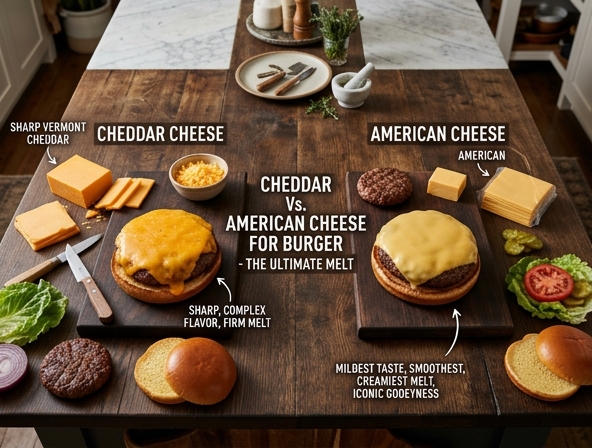
| Feature | Sharp Cheddar | American Cheese |
|---|---|---|
| Melting Quality | Prone to splitting and separation. | Remains smooth and creamy. |
| Stability | Low; often slips off the patty. | High; retains structural integrity. |
| Composition | Natural; moisture content causes issues. | Processed; optimized emulsification. |
| Best For | Flavor profile (but requires care). | The ultimate "perfect melt" burger. |
Cheddar Vs. American Cheese For Burgers: The Ultimate Melt
The burger is a culinary icon, a masterpiece of protein, fat, and texture. While the patty is the heart of the burger, the cheese is its soul. It is the bridge between the toasted bun and the savory crust of the meat. But when you stand before the deli counter or browse the refrigerated aisle, a classic debate arises: should you go for the sophisticated, sharp complexity of aged Cheddar, or the unapologetic, gooey performance of American cheese? In the quest for the ultimate melt, the answer is rarely black and white.
The Science of the Melt
To understand the rivalry between Cheddar and American cheese, one must first look at the science of protein and fat. Cheese is essentially a complex emulsion of milk proteins (casein), water, and butterfat. When you heat a natural cheese like Cheddar, the proteins begin to denature and lose their structure. As they contract, they squeeze the liquid fat out. This is why a high-quality aged Cheddar, when placed on a hot patty, often separates into a pool of oily grease surrounded by clumps of curd-a phenomenon known as "breaking."
American cheese, however, is a different beast entirely. It is technically a "pasteurized process cheese product." During its manufacture, producers take natural cheeses and add emulsifying salts-most importantly, sodium citrate. These salts act as a chemical stabilizer, preventing the proteins from binding too tightly and keeping the fat locked within the protein matrix even as it hits the high heat of a searing burger patty. The result? A uniform, luxurious, velvet-like melt that coats the meat rather than sliding off it.
American Cheese: The Unsung Hero of the Griddle
For decades, American cheese has suffered from a reputation problem. Viewed by some as "fake" or overly processed, it is often dismissed by culinary purists. Yet, in the professional kitchens of the world's most renowned burger joints, American cheese is the gold standard. Why? Because it behaves perfectly.
- Structural Integrity: American cheese doesn't just melt; it drapes. It flows over the contours of the patty and into the crannies of the bun, creating a seal that keeps the burger moist.
- Salt and Umami: The processing additives often provide a clean, salty punch that complements the beefy flavor of a patty without overpowering it.
- Consistency: Whether you prefer the classic Kraft Deli Deluxe or a high-end boars-head style, American cheese offers a predictable melt every single time.
If your goal is the "classic diner-style burger"-the kind with a thin, crispy-edged patty and a soft potato bun-American cheese is not just an option; it is the correct choice.
The Case for Cheddar: Flavor Above All
If American cheese is the workhorse, Cheddar is the artisan. When you choose Cheddar, you are choosing flavor. Depending on its age, a good sharp Cheddar brings notes of nuttiness, fruitiness, and a distinct tangy acidity that cuts through the richness of the beef fat.
However, working with Cheddar requires a bit of strategy. Because it is prone to breaking, you cannot simply throw a thick slab on a burger and expect it to behave. If you are determined to use Cheddar, consider these techniques:
- Grate, Don't Slice: Grating the cheese increases the surface area, allowing it to melt faster and more evenly before the fat has a chance to separate.
- Control the Age: Skip the three-year aged extra-sharp block for burgers. It is too dry and won't melt properly. Opt for a mild or medium Cheddar, which has higher moisture content and better melting properties.
- The "Chef's Trick": If you are a die-hard Cheddar fan, toss your grated cheese with a pinch of cornstarch before melting. This helps stabilize the emulsion, mimicking some of the benefits of processed cheese without sacrificing the flavor profile.
The Head-to-Head: Texture vs. Taste
The choice between these two comes down to a fundamental question: What is the primary function of the cheese on your burger? If the burger is a "smash burger" or a basic backyard grilled patty, the goal is often harmony. You want the cheese to melt into the meat, adding moisture and salt. Here, the "cling" of American cheese wins.
If you are building a "gourmet" burger-perhaps with caramelized onions, thick-cut bacon, and a brioche bun-a mild, creamy Cheddar might provide the structural and flavor depth needed to stand up to the other bold ingredients. The slight oiliness of a good Cheddar can actually serve as a condiment, mingling with the juices of the meat to create a decadent sauce.
Finding the Middle Ground: The Hybrid Approach
Do you have to choose? Modern burger culture says no. Many top-tier chefs now utilize a "cheese blend" strategy. By combining the structural benefits of American cheese with the bold flavor profile of Cheddar, you get the best of both worlds.
You can achieve this at home by making a quick *mornay* sauce or a "nacho-style" cheese sauce using a blend of high-quality mild Cheddar and a touch of sodium citrate (which is available to home cooks online). By emulsifying the Cheddar yourself, you get that intense, sharp, real-cheese flavor, but with the indestructible melt of a slice of processed American.
The Verdict
The debate between Cheddar and American cheese is a reflection of how we view food. Are we looking for the comfort and reliability of a well-engineered experience, or the nuance and intensity of real-food ingredients?
For the nostalgic, diner-style smash burger, stay loyal to American cheese. Its ability to create a seamless bond between patty and bun is unmatched in the culinary world. But for the weekend grill-master looking to elevate the burger into a complex, nuanced dish, don't be afraid to experiment with mild Cheddars, or better yet, build your own hybrid melt.
Ultimately, the "Ultimate Melt" isn't defined by the brand on the package, but by how well it integrates with the rest of your burger components. Whether you choose the reliable yellow square or the crumbly block, ensure your heat is low, your timing is precise, and your appetite is ready. After all, a burger without cheese is just a sandwich-and nobody wants that.
Disclaimer:
The information provided on Eateryn is for general educational and informational purposes only and is not intended as medical, nutritional, or healthcare advice. It should not be used to diagnose, treat, cure, or prevent any disease or medical condition.
Always consult a qualified physician, registered dietitian, or other certified healthcare professional before making changes to your diet, exercise routine, or lifestyle, or regarding any medical questions or concerns you may have. Never disregard or delay seeking professional medical advice because of something you have read on this website.