
Cast Iron vs Dutch Oven for Fried Chicken - Maintaining Consistent Frying Heat
Optimizing Frying Heat Dynamics
Achieving the perfect, crispy fried chicken often proves difficult due to fluctuating oil temperatures. While cooks traditionally rely on standard cast iron skillets, many now pivot to deep-walled Dutch ovens for thermal stability. Selecting the ideal vessel guarantees the mass required for professional results. Note: performance varies by thickness and coating. Comparing tools like Lodge skillets against Le Creuset pots demonstrates how material mass impacts heat recovery. This analysis examines which vessel offers superior consistency.
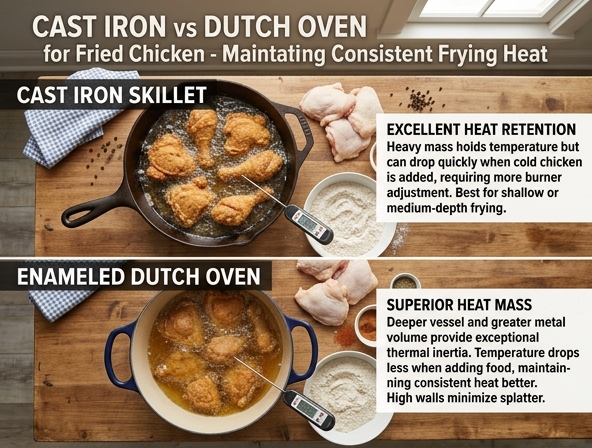
| Feature | Cast Iron Skillet | Dutch Oven |
|---|---|---|
| Best Use | Standard shallow frying | Deep frying with high oil volume |
| Thermal Stability | Moderate; susceptible to temperature drops | High; superior mass maintains heat |
| Heat Recovery | Variable based on thickness | Excellent due to deep-walled design |
| Key Advantage | Accessibility and ease of use | Professional-level consistency |
| Factors to Consider | Brand (e.g., Lodge) and material mass | Coating and wall thickness (e.g., Le Creuset) |
Cast Iron vs. Dutch Oven for Fried Chicken: The Battle for Thermal Consistency
For the home cook aiming to achieve that elusive, textbook-perfect fried chicken-shattering, golden-brown crust on the outside and succulent, steaming meat on the inside-the vessel you choose is just as important as the marinade, the flour dredge, or the oil temperature itself. While many kitchen veterans will insist that cast iron is the only way to go, the Dutch oven has gained significant ground as a superior tool for maintaining the precise thermal environment required for deep frying. But which one is truly the master of the fry?
The Physics of Frying: Heat Recovery and Thermal Mass
To understand the difference between a cast iron skillet and a Dutch oven, one must first understand the primary enemy of good fried chicken: the temperature drop. When you drop cold or room-temperature chicken into hot oil, the surface temperature of that oil plummets instantly. If the vessel doesn't have enough "thermal mass"-the ability to hold and radiate heat back into the oil-it will struggle to recover to the optimal frying range of 350°F to 375°F. If the oil stays too cool for too long, the crust becomes greasy and sodden as the breading absorbs the oil rather than searing it.
The Case for the Cast Iron Skillet
The cast iron skillet is the heritage choice. Its shallow depth and wide surface area make it the classic instrument for "pan-frying" or shallow-frying chicken. Because the skillet is heavy, it does possess a decent amount of thermal mass, but its design is inherently flawed for maintaining deep-fry consistency.
- Pro: Shallow Oil Usage. You use less oil to fry a batch, which is more economical.
- Pro: Surface Area. The wide diameter allows you to fry several pieces side-by-side without them touching, ensuring even browning.
- Con: Temperature Fluctuations. Because the oil is shallow, the introduction of a single large breast can drop the oil temperature significantly. Without the volume of oil to buffer the heat, the temperature swings are wild and difficult to control.
- Con: The Splash Factor. Shallow pans offer little protection against the inevitable popping and splattering of hot oil, which can be a deterrent for many cooks.
The Case for the Dutch Oven
The Dutch oven, particularly the enameled cast iron variety or raw cast iron, is essentially a deep-frying powerhouse. The tall walls and dense base are specifically designed for long-term heat retention, making it a favorite for braising, but these same qualities make it the gold standard for deep frying.
- Pro: Volume-Induced Stability. A Dutch oven allows you to use three to four inches of oil. This large volume acts as a heat sink. When the chicken enters the oil, the mass of the surrounding hot oil is so great that the temperature drop is minimal, leading to a faster recovery time and a crispier result.
- Pro: Vertical Heat Control. The height of the walls creates a stable environment that traps a layer of hot air above the oil, preventing the exterior of the chicken from cooling down too rapidly while the internal temperature rises.
- Pro: Safety. The deep walls act as a shield, containing the splatter and reducing the risk of fire or burns on your stovetop.
- Con: Capacity Constraints. While the volume is great, the smaller diameter means you have to fry in smaller batches to avoid overcrowding, which can cause the pieces to steam rather than fry.
Maximizing Your Vessel's Performance
Regardless of which vessel you choose, maintaining consistent heat is about managing your variables. Whether you are using a skillet or a Dutch oven, your strategy should revolve around three pillars: batch sizing, temperature monitoring, and pre-heat management.
1. Never Overcrowd: The most common mistake is cramming too much chicken into the pot. If the chicken is too crowded, the oil temperature will crash, and the moisture released from the chicken will cause the breading to slough off. In a Dutch oven, keep it to 3 or 4 pieces at most. In a skillet, ensure there is at least an inch of space between each piece.
2. Use a Thermometer: Relying on the "eye test" or a piece of bread is a recipe for inconsistency. Use a digital probe thermometer clipped to the side of your vessel. If you are using a Dutch oven, you have a much wider margin for error, but you must still adjust your burner intensity the moment the chicken hits the oil to counteract the initial drop.
3. The "Recovery" Burner Bump: When you lower your chicken into the oil, your thermometer will read a drop. Immediately bump your burner to high for about 30 to 60 seconds to push the temperature back up to your target, then dial it back to medium-high. A Dutch oven is particularly responsive to this technique because its thick walls are excellent at storing that extra burst of energy you just pumped into it.
The Verdict: Which Should You Choose?
If your goal is authentic, Southern-style "pan-fried" chicken-where the skin is slightly flatter and the chicken has been cooked in a smaller amount of fat-the cast iron skillet is your companion. It provides a unique texture and a crust-to-meat ratio that feels traditional and rustic.
However, if your goal is the "restaurant-quality" fried chicken-shattering, light, airy, and perfectly consistent from the first batch to the last-the Dutch oven is the superior tool. Its ability to maintain a steady temperature despite the addition of cold protein makes it the most reliable vessel for the home chef. It provides a level of thermal stability that a shallow skillet simply cannot match, ensuring that every bite of your chicken is as golden and crunchy as the last.
Ultimately, the best vessel is the one you know how to master. Whichever you choose, invest in a quality thermometer, watch your oil volume, and never sacrifice temperature for speed. With the right technique, both can lead you to fried chicken glory.
Disclaimer:
The information provided on Eateryn is for general educational and informational purposes only and is not intended as medical, nutritional, or healthcare advice. It should not be used to diagnose, treat, cure, or prevent any disease or medical condition.
Always consult a qualified physician, registered dietitian, or other certified healthcare professional before making changes to your diet, exercise routine, or lifestyle, or regarding any medical questions or concerns you may have. Never disregard or delay seeking professional medical advice because of something you have read on this website.