
Cast Iron Vs Baking Sheet For Buffalo Wings - Comparing Surface Heat Distribution
Achieving perfectly crispy Buffalo wings at home is a common challenge, as standard aluminum baking sheets often lack the thermal intensity required for optimal texture. While most recipes default to traditional sheet pans, cast iron's superior heat retention provides a more effective surface. Note that success requires precise oven calibration and seasoning maintenance. By comparing a heavy-duty Lodge skillet against a standard rimmed sheet, we will evaluate thermal distribution patterns to determine which method guarantees the best results.
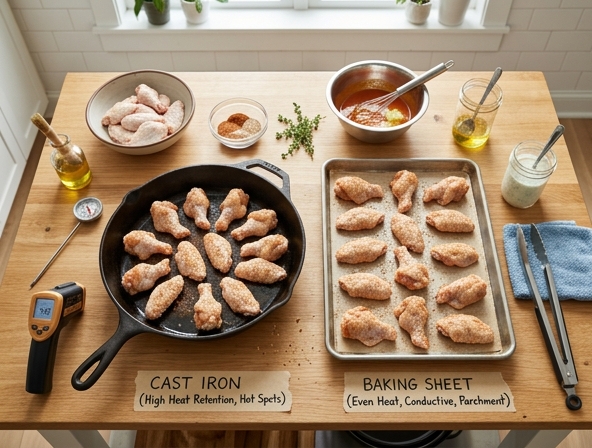
| Feature | Cast Iron (Skillet) | Standard Baking Sheet |
|---|---|---|
| Heat Retention | Superior; high thermal intensity | Standard; lacks deep intensity |
| Crispiness Outcome | Optimal texture for wings | Often challenging to achieve |
| Maintenance | Requires seasoning maintenance | Low maintenance |
| Key Requirement | Precise oven calibration | Standard setup |
Cast Iron Vs. Baking Sheet For Buffalo Wings: The Physics of the Perfect Crunch
For the home cook, the pursuit of the "restaurant-quality" buffalo wing-crispy, rendered skin with juicy, tender meat-is often a frustrating experiment in thermodynamics. While deep frying is the gold standard, it is messy and often impractical. Thus, the oven becomes our primary vessel. But when you open your kitchen cabinet, which tool should you reach for: the heavy-duty cast iron skillet or the humble, lightweight aluminum baking sheet? The answer lies in the nuanced science of surface heat distribution.
The Physics of Thermal Mass: The Case for Cast Iron
Cast iron is defined by one primary physical characteristic: high thermal mass. Because cast iron is dense, it possesses a significant capacity to store and retain heat. When you place a room-temperature (or refrigerator-cold) buffalo wing onto a preheated cast iron surface, the skillet doesn't "flinch." It maintains its temperature with remarkable stability.
In terms of surface heat distribution, cast iron excels at radiant heat intensity. Once the skillet is hot, it acts as a secondary heat source, radiating energy directly into the underside of the wing. This provides a consistent, aggressive sear that mimics the effect of a deep fryer's surface contact. The heat doesn't just transfer; it saturates the skin, forcing the rendered fat to bubble and fry the chicken in its own juices. The result is a deeply browned, caramelized crust that has a structural integrity capable of holding up to heavy sauces.
The Convection Advantage: The Case for the Baking Sheet
In contrast, a standard aluminum baking sheet operates on a completely different principle. Aluminum is highly conductive but has low thermal mass. It heats up quickly and loses heat just as fast. When you place a tray of cold wings onto a sheet, the surface temperature drops significantly, meaning the baking sheet relies far more on convection (the hot air circulating in the oven) than on direct conductive heat.
The baking sheet is often paired with a wire rack. This is a game-changer for surface heat distribution because it allows hot air to circulate underneath the wing, not just above it. While the cast iron provides a "pan-sear" finish, the baking sheet-and-rack combination focuses on uniform dehydration. By allowing airflow beneath the skin, the baking sheet excels at removing surface moisture-the primary enemy of the crispy wing-throughout the entire surface area of the chicken, rather than just the side touching the metal.
Comparing Surface Heat Distribution
When analyzing these two methods, we must look at how the metal interacts with the proteins and fats of the wing:
1. Thermal Conductivity and Recovery Time
Cast iron recovers its heat almost instantly after loading. This ensures that the bottom of the wing begins frying the moment it makes contact. However, if the pan is crowded, cast iron can lead to uneven results because the heat isn't being distributed by air, but by surface contact. If the wings aren't perfectly flush with the pan, you get uneven browning.
2. Radiant vs. Conductive Heat
The baking sheet, particularly when used with parchment or a rack, distributes heat more evenly across the entire batch. Because you aren't relying on the floor of the pan to do the heavy lifting, your wings will have a more uniform appearance. You won't have the "dark sear" of the cast iron, but you will have a consistent golden-brown finish across the whole tray.
The Role of Fat Rendering
Buffalo wings require the rendering of subcutaneous fat. This fat is essentially the "fryer oil" that crisps the skin from the inside out. In a cast iron skillet, the wings sit in a pool of rendered fat, essentially confiting the skin. This creates a very rich, oily, and intensely crispy texture. On a baking sheet, that fat drips away through the rack, resulting in a "cleaner" crispiness-less heavy, but perhaps slightly less decadent.
Practical Application: Which Should You Use?
Choose Cast Iron If:
- You are cooking a smaller batch of wings (6–10 pieces).
- You prefer a deep, dark sear and a "fried-like" mouthfeel.
- You enjoy the flavor profile of the chicken being finished in its own rendered fat.
Choose a Baking Sheet (with a Wire Rack) If:
- You are cooking for a crowd (20+ wings).
- You prefer a uniform, lighter crunch that won't get soggy under a heavy layer of Buffalo sauce.
- You want to ensure the entire wing, including the underside, is evenly dehydrated without flipping.
Conclusion: The Hybrid Strategy
If you want the ultimate Buffalo wing, consider the hybrid approach: use the cast iron to give the wings an initial, high-heat sear on the stovetop for two minutes per side to kickstart the fat rendering, then transfer them to a baking sheet to finish in the oven. This combines the superior conductive heat distribution of the cast iron with the optimal convection airflow of the baking sheet.
Ultimately, surface heat distribution is a balance between intensity and uniformity. Cast iron is the tool of the specialist-perfect for achieving high-heat intensity on a small scale. The baking sheet is the tool of the strategist-providing the necessary airflow to ensure that, no matter how many wings you are feeding, they all emerge from the oven with that elusive, satisfying crunch.
Disclaimer:
The information provided on Eateryn is for general educational and informational purposes only and is not intended as medical, nutritional, or healthcare advice. It should not be used to diagnose, treat, cure, or prevent any disease or medical condition.
Always consult a qualified physician, registered dietitian, or other certified healthcare professional before making changes to your diet, exercise routine, or lifestyle, or regarding any medical questions or concerns you may have. Never disregard or delay seeking professional medical advice because of something you have read on this website.