
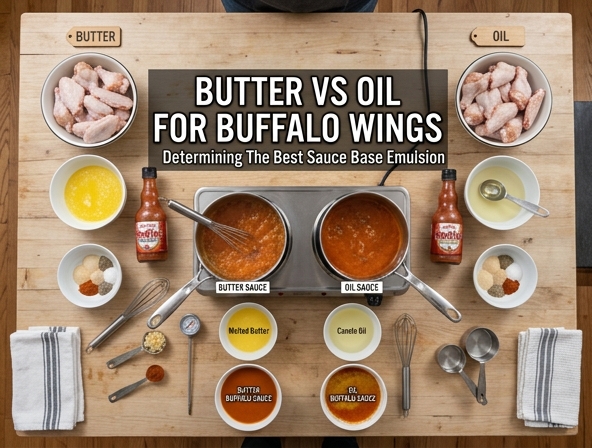
Butter Vs Oil For Buffalo Wings - Determining The Best Sauce Base Emulsion
Butter vs. Oil: Perfecting Buffalo Sauce
Achieving a stable, clingy buffalo sauce is a persistent challenge; thin, separated liquids often fail to coat wings effectively. While standard recipes favor simple butter-based mixes, these frequently break down under heat. True emulsification is the catalyst for superior flavor delivery.
Stipulation: While neutral oils provide structural stability, butter remains the gold standard for richness. Examples like clarified ghee or xanthan gum stabilizers illustrate this balance. We will evaluate how these fats define emulsion quality.
| Comparison Factor | Butter | Neutral Oil | Key Insight |
|---|---|---|---|
| Primary Role | Flavor and richness | Structural stability | Emulsification is key to a clingy sauce. |
| Performance | Gold standard for taste, but prone to breaking under heat. | Provides high stability and prevents liquid separation. | Balancing these fats is essential for quality. |
| Enhancements | Use clarified ghee for better consistency. | Not typically used alone due to lack of flavor. | Xanthan gum acts as a vital stabilizer. |
Butter Vs. Oil: Determining the Best Sauce Base Emulsion for Buffalo Wings
For the uninitiated, a Buffalo wing might seem like a simple equation: deep-fried chicken tossed in hot sauce. However, to the culinary purist, those wings represent a sophisticated exercise in fluid dynamics and emulsification. The difference between a wing that is adequately coated in a glistening, velvety glaze and one that is sitting in a pool of separated, watery vinegar is determined by one primary decision: the choice of fat.
Whether you are a home cook aiming to replicate the Anchor Bar experience or a professional chef looking to stabilize your sauce for high-volume service, understanding the interplay between butter and oil in your buffalo sauce emulsion is critical.
The Anatomy of Buffalo Sauce: A Stable Emulsion
At its core, a Buffalo sauce is an acidic foundation-typically a cayenne-based hot sauce like Frank's RedHot-that has been "mounted" with fat. Hot sauce on its own is thin, acidic, and aggressive. Without the addition of fat, it lacks the viscosity required to cling to the craggy, crispy exterior of a fried wing. The fat does three things: it tempers the acidity, provides a rich mouthfeel, and, most importantly, allows the sauce to emulsify.
An emulsion is a mixture of two liquids that normally do not mix (oil and water). In a Buffalo sauce, the hot sauce represents the aqueous phase, and the butter or oil represents the lipid phase. To create a sauce that doesn't "break" (separate into distinct layers), we need a stabilizer.
The Case for Butter: The Traditionalist's Choice
Butter is the gold standard for Buffalo wings, and for good reason. When you combine melted butter with hot sauce, you aren't just adding fat; you are adding water, milk solids, and proteins. These components act as natural emulsifiers. The proteins in the butter help bridge the gap between the water-based hot sauce and the fat molecules, creating a creamy, opaque emulsion that coats the wing with a luxurious, velvety finish.
The Pros:
- Flavor: The milky, savory profile of butter rounds out the sharp heat of cayenne peppers.
- Appearance: Butter creates a signature opaque, orange "glow" that is synonymous with authentic Buffalo style.
- Texture: Because butter has a lower melting point, it provides a "snap" of richness that coats the palate immediately upon the first bite.
The Cons:
- Temperature Sensitivity: Once the wings cool, the butter begins to solidify. If you've ever had a "day-old" Buffalo wing, you know the unpleasant, waxy texture of congealed butter.
- Shorter Shelf Life: Due to the milk solids, butter-based sauces are more prone to spoiling if not kept at proper temperatures.
The Case for Neutral Oil: The Modernist's Approach
While butter is traditional, many commercial kitchens and modernist cooks have pivoted toward neutral oils-such as canola, grapeseed, or high-quality avocado oil. From a technical standpoint, oil allows for a more stable emulsion that holds up to varying temperatures and extended holding times.
The Pros:
- Stability: Oil remains liquid at room temperature. A sauce made with oil will never congeal, making it the superior choice for catering, buffets, or delivery services.
- Purity of Flavor: A neutral oil does not interfere with the flavor profile of the hot sauce. If you are using a craft or habanero-based hot sauce, the oil lets the complexity of the peppers shine through without the interference of dairy.
- Mouthfeel: When emulsified correctly, oil creates a "glossier," more professional shine that persists longer than a butter-based sauce.
The Cons:
- Lack of Natural Emulsifiers: Pure oil has no milk solids to help it bind to the hot sauce. To make this work, you often need to introduce an external emulsifier-such as a touch of Dijon mustard, lecithin, or a pinch of xanthan gum-to keep the sauce from splitting.
- Missing "Richness": You lose that classic, creamy butter finish that many diners associate with "comfort food."
The Science of Emulsification: Making It Stick
Regardless of whether you choose butter or oil, the process of emulsification is the same. Simply stirring the fat into the sauce is insufficient; you need to create a stable dispersion of droplets.
If you are using butter, use an immersion blender while the sauce is warm. The mechanical energy of the blender breaks the butter into microscopic droplets, forcing them to bond with the vinegar in the hot sauce. If you are using oil, the immersion blender is mandatory. Add the oil in a slow, steady stream while the blender is running (much like making a mayonnaise) to ensure a perfectly smooth consistency that will cling to the chicken skin.
The "Third Way": Hybrid Emulsions
The most successful commercial Buffalo sauces often utilize a hybrid approach. Chefs will use a base of clarified butter (which has the milk solids removed, preventing spoilage) combined with a small amount of neutral oil and a stabilizer like xanthan gum.
This "hybrid" sauce offers the best of both worlds: the flavor of butter, the sheen and stability of oil, and the shelf-life resilience required for a modern kitchen. A mere 0.1% of xanthan gum by weight can turn a watery, broken mess into a thick, clinging glaze that stays on the wing from the fryer to the plate, regardless of how long the sauce sits in the warmer.
Final Verdict: Which Should You Use?
If you are cooking at home for immediate service, high-quality unsalted butter is the indisputable winner. The natural emulsifying properties of the milk solids coupled with the indulgent flavor profile are hard to beat for a backyard wing night.
However, if you are preparing wings for a crowd, a tailgate, or a business where the wings may sit for longer than 15 minutes, neutral oil-backed by a tiny amount of stabilizer-is the more professional choice. It ensures that every wing, from the first to the last, receives the same consistent, glossy, and delicious coating.
Ultimately, the "best" sauce base is the one that stays on the wing. By respecting the chemistry of your chosen fat and applying the proper mechanical energy, you can elevate your Buffalo wings from a messy snack to a perfectly glazed culinary masterpiece.
Disclaimer:
The information provided on Eateryn is for general educational and informational purposes only and is not intended as medical, nutritional, or healthcare advice. It should not be used to diagnose, treat, cure, or prevent any disease or medical condition.
Always consult a qualified physician, registered dietitian, or other certified healthcare professional before making changes to your diet, exercise routine, or lifestyle, or regarding any medical questions or concerns you may have. Never disregard or delay seeking professional medical advice because of something you have read on this website.