
Butter vs Lard for Apple Pie - Defining the Ultimate Flaky Crust
Butter vs Lard for Apple Pie: Defining the Ultimate Flaky Crust
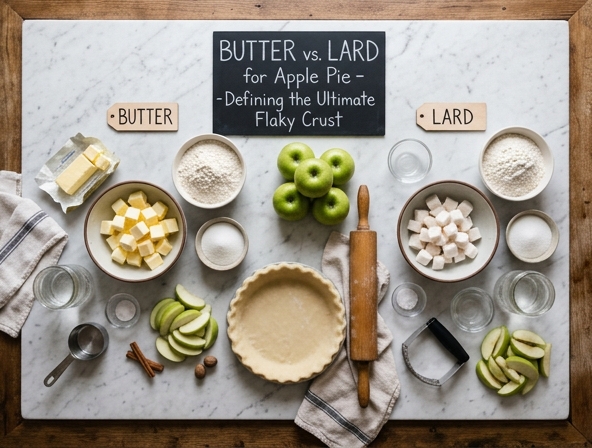
Achieving the quintessential flaky apple pie crust remains a persistent challenge for home bakers. While many rely exclusively on conventional butter, mastering the chemistry of fats is essential for professional-grade results. Understanding the unique properties of butter versus lard grants you total control over texture and flavor. Note: Temperature regulation is the true catalyst for success. Leading pastry chefs often utilize a specific lard-butter hybrid for structure. This guide examines how these fats define your pastry's final performance.
| Aspect | Details |
|---|---|
| Core Objective | Achieving a quintessential, professional-grade flaky apple pie crust. |
| Fat Chemistry | Understanding the unique properties of butter versus lard is essential for controlling texture and flavor. |
| Critical Success Factor | Strict temperature regulation of fats is the most important catalyst for pastry performance. |
| Expert Recommendation | Pastry chefs often prefer a lard-butter hybrid to balance structural integrity with flavor. |
The Great Pie Debate: Butter vs. Lard in the Pursuit of the Perfect Crust
For many home bakers, the apple pie is the final frontier. It is an exercise in patience, technique, and, perhaps most contentiously, ingredient selection. While the filling-a symphony of tart Granny Smiths, sweet Honeycrisps, cinnamon, and nutmeg-is vital, the true soul of the apple pie lies in the crust. Specifically, the battle between butter and lard has raged in American kitchens for generations. Each fat brings a distinct chemical and sensory profile to the table, and choosing the right one is the difference between a crust that is merely functional and one that is transformative.
The Case for Butter: Flavor and Aesthetics
Butter is the gold standard for most modern bakers, and for good reason. Primarily composed of about 80–82% butterfat and 16–18% water, butter provides a rich, decadent flavor profile that is nearly impossible to replicate. When butter hits the high heat of an oven, the water content turns to steam, helping to lift the layers of dough and create that signature "puff."
Beyond the taste, butter contributes a beautiful, golden-brown hue to the finished pastry. Because of its milk solids, butter undergoes the Maillard reaction, resulting in a nutty, toasted aroma that perfectly complements the sweetness of baked apples. However, butter is not without its challenges. Because it has a relatively low melting point, it can be notoriously difficult to work with. If your kitchen is even slightly warm, or if your hands are particularly heat-prone, the butter will soften too quickly, leading to a greasy dough that loses its structural integrity. When this happens, the butter leaks out during baking, leaving you with a crust that is more crunchy than flaky.
The Lard Legacy: Texture and The "Flake" Factor
If butter is the champion of flavor, lard is the undisputed king of texture. For much of American history, lard-rendered pig fat-was the primary cooking fat. It wasn't until the mid-20th century, with the rise of industrial vegetable shortenings and a shift in dietary attitudes toward animal fats, that butter became the default choice.
Lard differs from butter in a fundamental way: it is 100% fat. It contains no water and no milk solids. This unique composition is why lard creates a crust of unparalleled flakiness. When you cut cold lard into flour, it maintains large, solid pockets. During the baking process, these pockets don't melt as quickly as butter, allowing the steam to create distinct, wide layers of dough. The result is a crust that shatters upon impact, melting away instantly on the palate.
It is critical, however, to distinguish between commercial lard and "leaf lard." The former, often found in tubs at standard grocery stores, may be hydrogenated and processed, sometimes carrying a subtle "porky" flavor that can be off-putting in a sweet dessert. Leaf lard, which is rendered from the visceral fat around the pig's kidneys, is prized for its high quality and near-neutral flavor. When sourced correctly, leaf lard produces the cleanest, crispest, and most impressive crust imaginable.
The Science of the Crust: Fat vs. Flour
To understand why these fats behave differently, we must look at the science of gluten. Gluten is the protein structure that forms when flour is hydrated. In bread, we want lots of gluten for chewiness. In pastry, gluten is the enemy. We want to inhibit gluten development to ensure the dough remains tender.
Fats act as "shorteners"-they coat the flour proteins, preventing them from bonding with water. Because lard is 100% fat, it is technically a more efficient "shortener" than butter. Its ability to create distinct barriers between layers of dough is superior because it remains solid at room temperature for longer. Butter, conversely, provides flavor, but its water content can contribute to a slightly tougher crust if the baker isn't careful with the amount of moisture introduced during mixing.
The Hybrid Approach: The Professional's Secret
Is there a way to have your cake-or rather, your pie-and eat it too? Many professional pastry chefs argue that the ultimate apple pie crust is a 50/50 hybrid. By combining butter and lard, you achieve the best of both worlds: the rich, golden, toasted flavor of butter combined with the structural, delicate, and ultra-flaky performance of lard.
In this method, the lard provides the "heavy lifting" for the architecture of the crust, ensuring that the bottom stays crisp and the top is visibly flaky, while the butter provides the aromatic depth that makes the pie feel like a gourmet experience. For those hesitant to use lard, a blend is a fantastic entry point; you get the benefits of the rendered fat without the fat profile becoming overwhelming.
Technique Over Ingredient: The Final Verdict
Ultimately, the "best" crust is less about which fat you choose and more about how you handle it. Regardless of whether you use butter, lard, or a blend, the rules of pastry remain constant:
- Keep it cold: Your fat, your flour, and even your bowl should be chilled. The colder the fat, the better the flake.
- Minimal handling: Overworking the dough warms the fat and develops gluten. Mix until the dough just barely holds together.
- The Rest: Always let your dough rest in the refrigerator for at least an hour before rolling. This allows the flour to hydrate and the gluten to relax.
- The Bake: Start your pie at a high temperature (around 400°F/200°C) to lock in the shape, then lower it to finish cooking the filling thoroughly.
If you are looking for the classic, nostalgic experience of a Midwestern state-fair style pie, reach for high-quality leaf lard. If you are baking for a dinner party where the aroma and the golden color of the crust are the primary focus, stick with high-quality cultured butter. But if you are chasing perfection-a pie that is as structurally beautiful as it is delicious-try the hybrid approach. The interplay between the two fats creates a symphony of texture and taste that will elevate your apple pie from a simple dessert to an unforgettable masterpiece.
Disclaimer:
The information provided on Eateryn is for general educational and informational purposes only and is not intended as medical, nutritional, or healthcare advice. It should not be used to diagnose, treat, cure, or prevent any disease or medical condition.
Always consult a qualified physician, registered dietitian, or other certified healthcare professional before making changes to your diet, exercise routine, or lifestyle, or regarding any medical questions or concerns you may have. Never disregard or delay seeking professional medical advice because of something you have read on this website.