
Bone-In Vs Boneless For Buffalo Wings - Analyzing The Superior Meat-To-Sauce Ratio
The Wing Dilemma: Maximizing Flavor Efficiency
Choosing between bone-in wings and boneless tenders often results in disappointing flavor inconsistency. While traditionalists prioritize the authentic bone-in experience, others lean toward the convenience of processed cuts. The true culinary value lies in the meat-to-sauce ratio. Note that satisfaction hinges on cooking technique, not just poultry origin. By comparing traditional Buffalo drums against breaded tenders, we identify how surface area dictates sauce adherence. This analysis evaluates which format ultimately delivers a superior flavor profile.
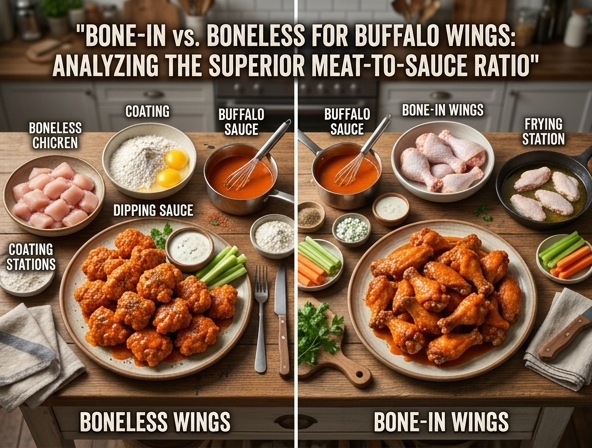
| Comparison Factor | Bone-In Wings | Boneless Tenders |
|---|---|---|
| Culinary Status | Traditional and authentic | Processed and convenient |
| Flavor Efficiency | High; based on natural meat-to-sauce ratio | Variable; based on breading and surface area |
| Sauce Adherence | Dependent on skin/bone surface | Dependent on breading texture |
| Primary Determinant | Cooking technique | Cooking technique |
| Key Takeaway | The superior experience is dictated by the meat-to-sauce ratio rather than the type of poultry cut used. | |
Bone-In Vs Boneless For Buffalo Wings: Analyzing The Superior Meat-To-Sauce Ratio
In the pantheon of bar food, few debates are as polarizing or as fiercely contested as the battle between bone-in and boneless buffalo wings. While some argue that it is merely a matter of personal preference or "laziness," the culinary reality is far more nuanced. At the heart of this conflict lies a specific metric that determines the ultimate success of the dish: the Meat-to-Sauce Ratio (MSR). Understanding how the physics of breading, the morphology of chicken cuts, and the mechanics of sauce adhesion interplay is essential for any connoisseur looking to optimize their wing-eating experience.
The Bone-In Perspective: The Purist's Playground
To understand the bone-in wing, one must appreciate the anatomy of the chicken wing-the "flats" and the "drums." From a culinary standpoint, the bone acts as a thermal conductor, distributing heat more evenly through the interior of the meat while the skin crisps rapidly on the outside. This creates a textural duality that is impossible to replicate in boneless varieties: the snap of the skin followed by the succulent, fatty meat within.
When it comes to the MSR, the bone-in wing relies heavily on surface area. The irregular topography of the wing-the nooks, crannies, and the cartilage at the ends-acts as a natural reservoir for Buffalo sauce. The skin, particularly when fried to a crisp, provides a porous surface that absorbs the vinegar-and-butter-based emulsion. Consequently, every bite of a bone-in wing offers a balanced ratio where the acidity of the sauce cuts through the natural fat of the skin, resulting in a high-intensity flavor experience. You aren't just eating meat; you are eating a vehicle for the sauce.
The Boneless Argument: Efficiency and Consistency
Critics of boneless wings often dismiss them as "glorified chicken nuggets," but this is a reductionist view. Boneless wings are typically cut from the breast, offering a much higher lean-meat-to-breading ratio. For those who prioritize the sheer volume of protein over the primal experience of navigating bone structure, boneless is the clear winner.
From an MSR standpoint, the boneless wing operates on a completely different set of principles. Because the meat is a uniform cube or strip of breast, it lacks the complex geography of a bone-in wing. To compensate, boneless wings are heavily breaded. This breading layer is the "sauce sponge." While the bone-in wing relies on skin to hold the sauce, the boneless wing relies on the breading. This results in a higher "sauce-to-meat" ratio in the outermost layer, which can be overwhelming if the sauce-to-biscuit ratio is not carefully managed by the kitchen. However, for those who love a "sauce-drenched" experience, the boneless wing is structurally designed to hold more liquid volume per square inch of meat than its bone-in counterpart.
The Physics of Sauce Adhesion
The success of a Buffalo wing is ultimately measured by how much sauce makes it from the bowl to your palate. This is a matter of surface tension and adhesion.
- Skin and Fat (Bone-in): The oil-rich skin of a bone-in wing interacts with the butter-based Buffalo sauce in a lipid-friendly embrace. The sauce doesn't just sit on top; it semi-emulsifies with the rendered chicken fat, creating a glossy, flavor-packed coating that clings to every crevice.
- Breading and Porosity (Boneless): The breading on a boneless wing is engineered to be thirsty. It acts as a wick, drawing the sauce deep into the crust. If the sauce is too thin, it runs off the breading, leaving the chicken soggy. If the sauce is properly thickened with butter or a starch base, the boneless wing becomes a masterpiece of uniform, saturated flavor.
Evaluating the Culinary Trade-offs
The superior MSR is ultimately subjective, depending on what the diner prioritizes. If your goal is to experience the interplay between rendered fat, crispy skin, and spicy sauce, the bone-in wing is untouchable. The bone forces a slower consumption rate, allowing the palate to process the complexity of the sauce in each bite. The ratio here is dynamic; it changes as you move from the center of the meat toward the crispy edges.
Conversely, the boneless wing offers a predictable, repeatable MSR. Each bite is consistent. This is the "utility" choice-ideal for those who want to maximize their intake of chicken without the mechanical tax of navigating bones. The ratio here is stable: you get a consistent percentage of meat, breading, and sauce in every mouthful. It is an optimized experience for those who prefer intensity over texture.
Conclusion: Choosing Your Champion
When analyzing the Meat-to-Sauce Ratio, the bone-in wing wins on complexity and the harmonious balance between chicken fat and cayenne-heavy sauce. It provides a deeper, more artisanal experience where the sauce highlights the natural quality of the poultry. The boneless wing, however, wins on sheer volume and sauce absorption capability. It is the efficient choice for the modern eater, providing a consistent MSR that guarantees a punch of flavor in every bite.
Ultimately, the "superior" wing is the one that best satisfies your current intent. If you seek a ritualistic, textured experience, reach for the bone-in flats. If you seek a high-output, consistently saucy protein delivery system, the boneless route remains the most logical choice. Regardless of the form, the integrity of the sauce-and its ability to marry with the meat-remains the true north star of the Buffalo wing world.
Disclaimer:
The information provided on Eateryn is for general educational and informational purposes only and is not intended as medical, nutritional, or healthcare advice. It should not be used to diagnose, treat, cure, or prevent any disease or medical condition.
Always consult a qualified physician, registered dietitian, or other certified healthcare professional before making changes to your diet, exercise routine, or lifestyle, or regarding any medical questions or concerns you may have. Never disregard or delay seeking professional medical advice because of something you have read on this website.