
Boiling Before Grilling vs Direct Grilling for Barbecue Ribs - Preserving Natural Juices
Many pitmasters struggle with ribs that end up dry or stringy despite their best efforts on the grill. While traditionalists often debate the merits of boiling versus direct grilling, the industry typically leans toward specific heat application strategies. Mastering this moisture-retention technique transforms your final outcome. Note that neither method is universally superior; results depend heavily on temperature control. Whether using slow-braising or direct smoking, this guide compares these approaches to ensure you achieve consistently succulent, competition-grade ribs.
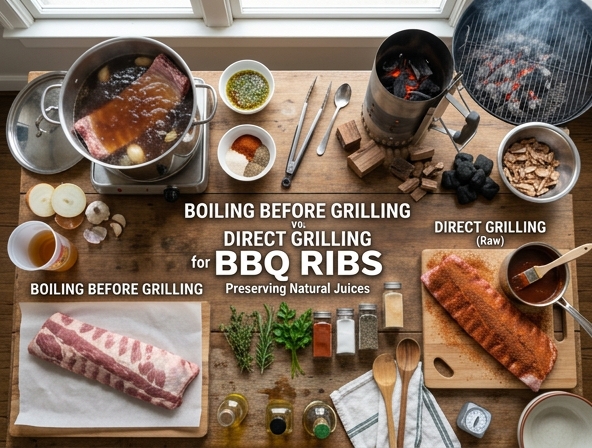
| Feature | Boiling / Braising | Direct Grilling / Smoking |
|---|---|---|
| Objective | Focuses on moisture retention through liquid-based heat. | Focuses on developing crust and smoky flavor profile. |
| Risk Factors | Risk of over-softening if timed incorrectly. | Risk of drying out if temperature is not managed well. |
| Key Requirement | Proper slow-braising technique. | Precise heat control. |
| Conclusion | Neither method is universally superior; success depends on mastering temperature and technique. | |
The Rib Revelation: Boiling vs. Direct Grilling for Maximum Moisture
In the hallowed world of barbecue, few topics spark as much fervor-and perhaps as much controversy-as the preparation of pork and beef ribs. For the backyard pitmaster, the goal is always the same: a rib that is tender enough to pull cleanly from the bone, yet firm enough to retain a satisfying bite, all while brimming with rich, succulent juices. Amidst the pursuit of this perfection, a persistent divide remains. On one side, the proponents of par-boiling claim it is the secret to foolproof tenderness. On the other, the barbecue purists insist that boiling is an unforgivable culinary sin, arguing that it leaches away flavor and ruins the integrity of the meat. To understand which method truly preserves the natural juices of your ribs, we must look beyond tradition and into the science of the protein itself.
The Case for Boiling: Convenience vs. Consequence
The practice of boiling ribs-often in a seasoned liquid, sometimes even with soda or vinegar-before placing them on the grill is rooted in a desire for tenderness. When you boil ribs, you are effectively braising them in water. The heat causes the collagen within the connective tissues to break down and transform into gelatin, which makes the meat feel "tender" much faster than any other method. For the novice cook, this provides a safety net; it ensures that even if their grilling technique is lacking, the meat will not be tough or rubbery.
However, there is a significant price to pay for this convenience. Meat is a complex matrix of muscle fibers, fat, and water. When you submerge ribs in boiling water, you initiate a process of extraction. Those precious water-soluble proteins, minerals, and the very fats that provide deep, savory flavor are drawn out into the boiling liquid. Once that water is discarded, you have effectively purged the ribs of the very elements that define a high-quality barbecue experience. Furthermore, boiling can lead to an undesirable texture. Because the meat cooks so quickly and uniformly, it can easily transition from "tender" to "mushy," losing the structure necessary for a clean, professional-looking rib.
The Direct Grilling and Smoking Approach: Respecting the Fat
On the opposite end of the spectrum, proponents of direct grilling, smoking, or "low and slow" cooking argue that the only way to preserve juice is to let the fat render internally. When ribs are cooked slowly over indirect heat-the preferred method of competition pitmasters-the process is gradual. This allows the intramuscular fat (the marbling) to slowly melt and bast the meat from the inside out.
Unlike boiling, which forces water into the meat only to have it evaporate rapidly on the grill, the smoking method relies on the Maillard reaction. This chemical reaction between amino acids and reducing sugars happens on the surface of the meat, creating a dark, flavorful "bark." This crust acts as a semi-permeable barrier, helping to seal in the rendered fats and natural juices rather than letting them escape. When you avoid the boil, the ribs maintain a density and complexity of flavor that simply cannot be replicated by pre-cooking in liquid.
The Science of Juiciness: Why Patience Wins
What we perceive as "juiciness" in a rib is not just moisture content; it is a combination of hydration and rendered fat. When you boil, you are dealing with a dilution problem. When you grill or smoke, you are managing a transformation problem. The collagen in the rib rack acts like a scaffold. If you boil it, you collapse that scaffold too quickly. If you roast or smoke it slowly, the collagen transforms into a rich, silky gelatin that coats the muscle fibers. This is the "mouthfeel" that aficionados crave. It provides the sensation of moisture without the meat feeling waterlogged.
Additionally, boiling strips away the exterior rub and spices that you have carefully applied. In a dry-heat or smoky environment, those spices toast and become aromatic, adhering to the surface of the meat and creating a depth of flavor that is essential to the overall barbecue profile. When you boil, you wash away that foundational seasoning, leaving the meat needing heavy dousing in sauce to compensate for the loss of flavor.
Finding the Middle Ground: The Technique of the Pros
If you find that your grilled ribs are coming out dry, the solution is not to boil them; it is to better manage your heat and moisture during the cooking process. For those who want the best of both worlds-the tenderness of a braise and the flavor of the grill-the "3-2-1" method is the industry gold standard.
- Phase 1: Smoke the ribs uncovered for three hours to develop the bark and introduce wood flavor.
- Phase 2: Wrap the ribs in foil (the "Texas Crutch") with a small amount of liquid-like apple juice, butter, or honey-for two hours. This creates a localized, steam-filled environment that tenderizes the ribs without the massive flavor loss associated with a full water boil.
- Phase 3: Unwrap and grill for the final hour to set the sauce and firm up the bark.
This hybrid approach allows you to control the tenderizing process while ensuring the meat remains seasoned and flavorful. You are not boiling the rib; you are steaming it in its own juices and the juices of your chosen braising liquid, which are then reabsorbed into the meat.
Conclusion: The Verdict on Rib Integrity
While boiling ribs is a convenient shortcut, it is fundamentally at odds with the goal of high-quality barbecue. By boiling, you prioritize speed over quality, sacrificing the rich, natural flavors trapped within the fats and connective tissues of the pork. To achieve the pinnacle of juiciness, one must embrace the time-honored practice of patience. Whether you are using a professional offset smoker or a backyard charcoal grill, the focus should always be on slow heat and indirect cooking. By letting the meat cook in its own rendering fat, you ensure that every bite is not just tender, but deeply flavorful-a true testament to the art of the grill.
Next time you face the rib dilemma, resist the temptation of the stockpot. Trust in the heat, trust in the smoke, and give your ribs the time they deserve. Your patience will be rewarded with a plate of ribs that are undeniably moist, structurally sound, and bursting with the kind of barbecue flavor that defines a master of the flame.
Disclaimer:
The information provided on Eateryn is for general educational and informational purposes only and is not intended as medical, nutritional, or healthcare advice. It should not be used to diagnose, treat, cure, or prevent any disease or medical condition.
Always consult a qualified physician, registered dietitian, or other certified healthcare professional before making changes to your diet, exercise routine, or lifestyle, or regarding any medical questions or concerns you may have. Never disregard or delay seeking professional medical advice because of something you have read on this website.