
Blind Baking vs No Blind Baking for Apple Pie - Achieving the Perfect Crisp Bottom
Blind Baking vs. No Blind Baking
A soggy bottom often ruins a beautifully crafted apple pie. While standard baking is the norm, it frequently traps fruit moisture, undermining the crust. Blind baking serves as a superior strategy to guarantee a crisp, stable base. Note that this requires precise heat management to avoid over-browning. Techniques like using ceramic pie weights or a preheated baking stone offer professional results. The following sections compare both methods to help you achieve the perfect, golden-brown crust.
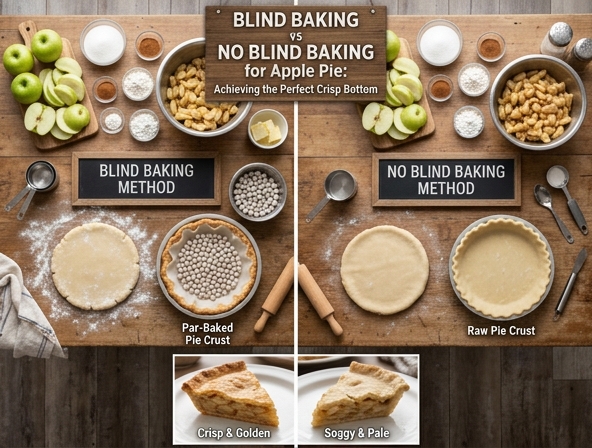
| Comparison Aspect | Blind Baking | No Blind Baking (Standard) |
|---|---|---|
| Core Purpose | Ensures a stable, crisp base. | Traditional assembly and baking. |
| Resulting Texture | Prevents sogginess; achieves a golden-brown finish. | Prone to becoming soggy due to fruit moisture. |
| Technique Requirements | Requires pie weights or a preheated baking stone. | None; simpler preparation. |
| Difficulty Level | Higher (requires precise heat management). | Lower (standard baking process). |
Blind Baking vs. No Blind Baking for Apple Pie: Achieving the Perfect Crisp Bottom
For many home bakers, the apple pie is the ultimate litmus test of culinary skill. It is a masterpiece of balance: the sweet-tart crunch of the fruit, the aromatic warmth of cinnamon and nutmeg, and, most importantly, the architecture of the crust. Yet, despite our best efforts, we have all encountered the dreaded "soggy bottom"-that pale, doughy, unappealing layer of pastry that sits beneath the filling, turning a crisp crust into a disappointing, moisture-laden mess.
This brings us to the great debate of the pastry world: to blind bake or not to blind bake? While blind baking is a non-negotiable step for custard-based pies like lemon meringue or quiche, its role in fruit pies-specifically the apple pie-remains a subject of fierce contention. Is it a secret weapon for achieving professional-grade texture, or is it an unnecessary, time-consuming hurdle?
Understanding the "Soggy Bottom"
To solve the problem, we must first understand the enemy. A soggy bottom occurs when the crust absorbs liquid faster than the starch can gelatinize or the moisture can evaporate. In an apple pie, this liquid comes from two primary sources: the juices released by the apples as they heat up and the melting fat within the pastry itself. If the oven temperature isn't high enough to set the crust before these juices seep in, the flour becomes saturated, preventing the crisp, flaky structure we crave.
The Case for Blind Baking: The Insurance Policy
Blind baking, or par-baking, involves partially baking the crust with weights (like ceramic beans or dried legumes) before the filling is added. When applied to apple pie, it serves as a structural insurance policy.
The Advantages:
- Structural Integrity: By pre-baking the bottom, you jump-start the gelatinization of the starches in the flour. This creates a barrier that makes the crust more resistant to fruit juices.
- Consistency: It guarantees that the bottom crust will achieve a golden-brown hue, regardless of how quickly the filling cooks.
- Fat Stability: It allows the fats to render and set correctly, ensuring that the final product maintains its crispness even after sitting on the counter for a few hours.
The Drawbacks:
- Complexity: It requires an extra step, cooling time, and the management of pie weights.
- Shrinkage Risk: If not handled correctly, the edges of the crust may slump or shrink during the blind bake, leaving you with a pie that has a gaping, uneven rim.
The "No Blind Bake" School: Embracing the All-in-One Method
Many traditionalists argue that blind baking is unnecessary for apple pie. Proponents of the "no-bake" approach suggest that with the right technique, you can achieve a perfectly crisp crust in one go. The secret, they argue, lies in thermodynamics rather than extra steps.
The "No Blind Bake" Tactics:
- The Pre-heated Baking Sheet: Placing your pie on a pre-heated heavy-duty baking sheet (or a pizza stone) is perhaps the most effective way to transfer heat directly to the base of the pan. This effectively "fries" the bottom crust in the first 15 minutes of baking.
- High-Heat Start: Starting the oven at a high temperature (425°F or 220°C) for the first 20 minutes before lowering it to finish baking ensures the crust sets rapidly.
- Pan Selection: Use metal pans, not glass or ceramic. Metal is highly conductive, meaning it transfers heat to the dough much faster, ensuring a crisp result.
Bridging the Gap: Tips for a Crisp Crust Regardless of Choice
Whether you choose to blind bake or take the all-in-one route, there are universal techniques that will significantly improve your chances of achieving that coveted crunch.
1. Manage the Maceration
The biggest mistake is adding raw, sugared apples directly to the crust. Let your sliced apples sit with sugar for 30–60 minutes, then drain the excess liquid. You can even boil that liquid down into a syrup to pour back into the pie. Less liquid at the start means less liquid trying to penetrate the crust.
2. The "Shield" Technique
Sometimes, we use a layer of protection. Some bakers brush the bottom crust with a thin layer of egg white or a light dusting of almond flour or crushed graham crackers. This acts as a moisture-wicking buffer, absorbing fruit juice before it hits the pastry.
3. Strategic Venting
Allowing steam to escape is vital. Ensure your top crust has generous vents, or use a lattice design. Steam trapped inside the pie acts as a recirculating humidifier, which is the natural enemy of a crisp crust.
The Final Verdict
If you are a beginner or prone to "soggy bottom" anxiety, blind baking is a reliable, albeit labor-intensive, path to success. It allows you to control the variables one by one.
However, for the baker looking for efficiency, the "No Blind Bake" method is entirely achievable. By switching to a metal pan, pre-heating your baking sheet, and meticulously managing your fruit juices, you can produce a pie that is every bit as crispy as a blind-baked version without the fuss.
Ultimately, the perfect apple pie is about the relationship between your oven's heat and the moisture content of your filling. Experiment with both methods, take notes on your results, and remember: even a slightly soggy bottom pie is still, at its heart, a delicious piece of homemade comfort.
Disclaimer:
The information provided on Eateryn is for general educational and informational purposes only and is not intended as medical, nutritional, or healthcare advice. It should not be used to diagnose, treat, cure, or prevent any disease or medical condition.
Always consult a qualified physician, registered dietitian, or other certified healthcare professional before making changes to your diet, exercise routine, or lifestyle, or regarding any medical questions or concerns you may have. Never disregard or delay seeking professional medical advice because of something you have read on this website.