
Bechamel vs Custard Style for Macaroni and Cheese - Comparing Creaminess Levels
Many home cooks struggle to achieve a silky, consistent texture in macaroni and cheese, often battling grainy or broken sauces. While traditional recipes rely on either a flour-based béchamel or an egg-tempered custard, selecting the right foundation is critical. Understanding how these distinct structures interact with fats ensures superior mouthfeel. Note that precise heat management remains mandatory for success. For instance, sharp Gruyère excels in béchamel, while Fontina creates a custard's signature richness. This guide evaluates both to help you perfect your dish.
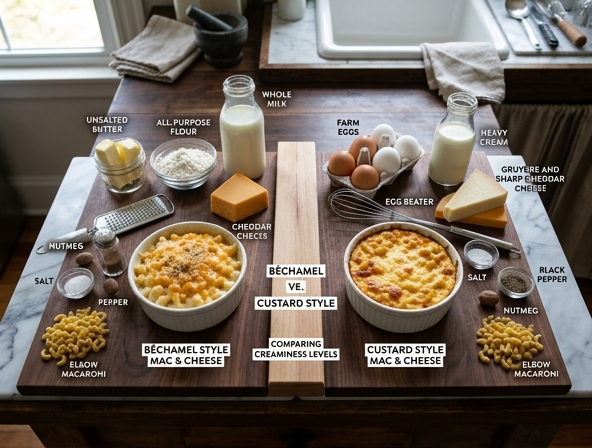
| Feature | Béchamel Style | Custard Style |
|---|---|---|
| Foundation | Flour-based roux | Egg-tempered |
| Texture Profile | Silky and consistent | Signature richness |
| Ideal Cheese Pairing | Sharp Gruyère | Fontina |
| Key Requirement | Precise heat management | Precise heat management |
| Common Struggle | Avoiding grainy or broken sauces | Avoiding curdling through temperature control |
The Great Macaroni Debate: Bechamel vs. Custard-Style Cheese Sauces
For many home cooks, macaroni and cheese is more than a meal-it is a culinary litmus test. The ideal version occupies a specific space in our collective memory: the pasta must be perfectly al dente, the cheese must be sharp yet smooth, and, above all, the sauce must achieve that elusive, harmonious level of creaminess. Yet, when you dig into the "how" of achieving that texture, you quickly run into a fork in the road: the Bechamel-based approach (the classic Mornay) versus the egg-heavy custard style.
The Bechamel Standard: The Engineering of Smoothness
The Bechamel-based macaroni and cheese-technically a Mornay sauce-is the backbone of modern French-inspired cooking and the gold standard for most stovetop-to-oven recipes. Its creation begins with a roux: a precise marriage of equal parts flour and fat (usually butter) cooked just long enough to remove the raw flour taste. Into this, milk or cream is whisked, transforming the mixture into a thick, white velouté. Finally, the cheese is folded in.
The Science of Stability: The primary advantage of the Bechamel method is stability. The starch from the flour acts as a thickening agent that prevents the proteins in the cheese from tightening up and separating into a greasy, curdled mess when exposed to high heat. This creates a matrix that holds the cheese emulsification together. If you prefer a sauce that maintains its velvetiness from the first bite to the last, and one that reheats beautifully the next day, the Bechamel is your champion. It offers a "nappant" consistency-meaning it coats the back of a spoon-resulting in a silky, pourable sauce that clings to every crevice of the macaroni.
The Custard Style: The Southern Heirloom
If the Bechamel method is an exercise in stability, the custard-style method is an exercise in structural transformation. Common in traditional Southern US kitchens, this approach replaces the flour-based roux with eggs. Often mixed with milk, heavy cream, or even evaporated milk, the eggs act as a binding agent that "sets" the dish in the oven. Unlike the stovetop Bechamel, which is a finished sauce before it hits the casserole dish, a custard-style mac is often assembled as a liquid that thickens and solidifies during the baking process.
The Texture of Richness: The custard method produces a final product that is more akin to a savory bread pudding or a quiche. When sliced, it holds its shape, providing a structural integrity that the Bechamel method cannot match. The mouthfeel is profoundly different; while the Bechamel is "creamy" in a fluid sense, the custard is "rich" in a dense, velvety sense. The eggs impart a golden hue and a deep, decadent weight that makes the dish feel like a main course rather than a side.
Comparing the Creaminess Levels
When we talk about "creaminess," we are actually discussing a complex intersection of viscosity, fat dispersion, and protein structure. Comparing the two methods reveals distinct tactile differences:
- Viscosity: Bechamel-based sauces have higher viscosity at lower temperatures, meaning they feel "goopier" and more immediately coat the tongue. Custard-based sauces feel lighter on the tongue initially but provide a denser, more substantial finish as you chew.
- Fat Dispersion: The flour in a Bechamel acts as a physical barrier that keeps fat globules suspended evenly throughout the sauce. In a custard, the egg protein forms a network that traps the fat. If not cooked carefully, the custard is prone to "weeping" or "breaking," which can lead to a grainier experience if the oven temperature is too high.
- Mouthfeel: The Bechamel provides a "slipperiness" that many associate with comfort food-it glides. The custard provides a "melt-in-your-mouth" experience, reminiscent of a custard pie or a baked soufflé, which feels more sophisticated and indulgent.
The Risks and Rewards
Every culinary choice comes with its own set of trade-offs. The Bechamel method is technically safer; it is highly forgiving and resistant to temperature fluctuations. Its main weakness is the "flour factor"-if the roux isn't cooked correctly, you may end up with a grainy, starchy aftertaste that detracts from the purity of the cheese. To mitigate this, many chefs now turn to sodium citrate, an emulsifying salt that can turn any cheese into a liquid gold sauce without a single grain of flour, offering a "third way" that mimics the smoothness of Bechamel without the heaviness.
The custard method, conversely, requires a watchful eye. Because eggs coagulate at specific temperatures, a custard-style mac and cheese can quickly turn into scrambled eggs if the oven heat is not controlled, or if the pasta is not properly drained. However, when executed perfectly, the custard style produces a superior browned crust on top, as the egg proteins participate in the Maillard reaction more effectively than the simple butter and starch of a Bechamel crust.
Which Style Should You Choose?
The decision ultimately boils down to the desired dining experience. Are you aiming for a decadent, quick-serve comfort dish that feeds a crowd and is guaranteed to be smooth every time? Go with the Bechamel. Its reliability and "pourability" make it the king of the potluck.
However, if you are looking to create a centerpiece dish-something that sits proudly on the table, can be cut into squares, and offers a dense, luxurious texture that feels like a labor of love-the Custard style is unrivaled. It is a dish that invites you to slow down and savor the density of the cheese-egg-cream triumvirate.
Ultimately, both methods seek to solve the same problem: how to keep cheese, fat, and moisture in a perpetual state of delicious, creamy union. Whether you lean toward the starchy stability of the French roux or the protein-based structure of the Southern custard, the secret to the perfect macaroni and cheese will always remain the same: high-quality cheese, fresh cream, and a mindful approach to temperature control.
Disclaimer:
The information provided on Eateryn is for general educational and informational purposes only and is not intended as medical, nutritional, or healthcare advice. It should not be used to diagnose, treat, cure, or prevent any disease or medical condition.
Always consult a qualified physician, registered dietitian, or other certified healthcare professional before making changes to your diet, exercise routine, or lifestyle, or regarding any medical questions or concerns you may have. Never disregard or delay seeking professional medical advice because of something you have read on this website.