
Baking Powder vs Baking Soda for Pancakes - Rising to the Occasion
Baking Powder vs. Baking Soda for Pancakes: Rising to the Occasion
Achieving the perfect, fluffy pancake remains a common culinary struggle for many home cooks. While standard commercial mixes often rely on stabilizers, the true secret lies in specific leavening agents. Understanding their role creates a dramatic shift in structural integrity.
Stipulation: Baking soda requires acidic components like buttermilk to activate, while baking powder functions independently. Utilizing the correct reaction ensures maximum lift. The following analysis explores these chemistry essentials to elevate your breakfast game.
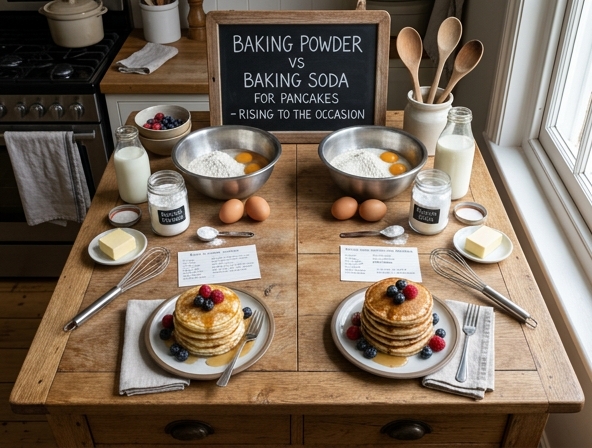
| Leavening Agent | Activation Requirement | Primary Function |
|---|---|---|
| Baking Soda | Requires an acidic component (e.g., buttermilk) to activate. | Provides chemical lift through an acid-base reaction. |
| Baking Powder | Functions independently without extra acids. | Ensures consistent structural integrity and rise. |
| Summary: Selecting the correct leavening agent is essential for achieving the ideal fluffy pancake texture. | ||
Baking Powder vs. Baking Soda for Pancakes: Rising to the Occasion
There is a singular, golden moment in the life of a pancake enthusiast: the precise second you flip that golden-brown disc and see the tiny, porous bubbles-the "eyes" of the pancake-peeking through the batter. This airy, light texture isn't just a happy accident; it is the result of precise chemistry. At the heart of this morning miracle lie two unassuming white powders that reside in nearly every pantry: baking soda and baking powder. While they look identical and share the same goal-leavening-they are not interchangeable. Understanding the difference is the secret to graduating from flat, rubbery hotcakes to the towering, cloud-like stacks of your dreams.
The Fundamental Chemistry: Acids and Bases
To understand why these powders act the way they do, we have to look at the chemistry of leavening. Leavening agents are substances that create gas (carbon dioxide) in a batter, causing it to expand. This gas gets trapped in the protein structure of the flour and egg, creating the airy crumb we crave.
Baking soda, or sodium bicarbonate, is a pure base. Because it is alkaline, it requires an acidic ingredient in your recipe to trigger a reaction. When baking soda meets an acid-such as buttermilk, yogurt, lemon juice, or cocoa powder-it immediately produces carbon dioxide. The reaction is fast and vigorous.
Baking powder, on the other hand, is a more complete package. It consists of baking soda mixed with a powdered acid (typically cream of tartar) and a moisture-absorbing agent like cornstarch to keep it stable. Because the acid is already built-in, baking powder only requires moisture and heat to activate. Most modern baking powders are "double-acting," meaning they react once when they hit the liquid batter and again when they encounter the heat of your griddle.
The Case for Baking Soda
Baking soda is the powerhouse of the leavening world. It is about three to four times stronger than baking powder. Because of this potency, you only need a small amount to achieve significant lift. However, because it is so basic, it requires a careful balance of acidity. If you add too much baking soda without enough acid to neutralize it, your pancakes will taste metallic, soapy, and unpleasant. They may also turn a strange, yellowish-green hue.
Using baking soda is ideal if your recipe relies on tangy ingredients like buttermilk or sour cream. The soda reacts with the tang, neutralizing the acidity to create a balanced flavor while generating plenty of carbon dioxide. If you are a fan of thin, delicate crepes or specific types of buttermilk pancakes, baking soda is your best friend.
The Case for Baking Powder
Baking powder is the reliable workhorse of the home baker. Because the acid is already included, you don't have to worry about the pH balance of your other ingredients. This makes it incredibly convenient for recipes that use neutral liquids like whole milk or even just water.
The "double-acting" nature of baking powder provides a safety net. The first reaction, which occurs the moment the wet and dry ingredients mix, helps create the initial lift. The second reaction, which occurs in the pan, ensures that the pancake continues to grow as the proteins in the egg and flour set. This leads to a more uniform, predictable rise, making baking powder the go-to for standard, fluffy, American-style pancakes.
The "Hybrid" Approach: Using Both
Many professional pancake recipes call for both baking soda and baking powder. Why? It's all about control. The baking powder provides a reliable, steady lift throughout the cooking process, while the baking soda provides a quick "boost" of aeration right at the start and helps neutralize the acidity of ingredients like buttermilk or cocoa. Using a combination allows the cook to achieve the perfect balance of tenderness, lift, and flavor without having to risk the metallic taste of too much soda.
Troubleshooting Your Rise
Even with the right ingredients, pancakes can sometimes fall flat. Here are the most common culprits:
- Expired Leavening: Baking powder and baking soda lose their potency over time. If they've been sitting in your cupboard for more than six months, they may be "dead." You can test baking powder by dropping a half-teaspoon into a cup of hot water; if it doesn't fizz aggressively, it's time for a new tin.
- Over-mixing the Batter: This is the cardinal sin of pancake making. If you mix your batter until it is perfectly smooth, you develop too much gluten. This results in a chewy, tough pancake that can't trap the gas bubbles created by your leavening. Aim for a "lumpy" batter-if there are still streaks of flour, that's actually good.
- The Resting Period: If you use baking powder, let your batter rest for at least 10 minutes before cooking. This gives the double-acting agents time to hydrate and start the first stage of the chemical reaction.
Final Verdict: Which Should You Use?
Ultimately, the choice depends on your desired outcome. If you want a tall, thick, fluffy stack, a combination of baking powder with a touch of baking soda is the gold standard. If you are making traditional, tangy buttermilk pancakes, ensure the baking soda is front and center to interact with that lactic acid.
Baking, even for a quick breakfast like pancakes, is a science. By understanding how these leavening agents react with the other components in your bowl, you gain the power to manipulate texture and flavor. So, the next time you reach for those white powders, remember: you aren't just making breakfast; you're engaging in a precise, delicious chemical reaction. Happy flipping!
Disclaimer:
The information provided on Eateryn is for general educational and informational purposes only and is not intended as medical, nutritional, or healthcare advice. It should not be used to diagnose, treat, cure, or prevent any disease or medical condition.
Always consult a qualified physician, registered dietitian, or other certified healthcare professional before making changes to your diet, exercise routine, or lifestyle, or regarding any medical questions or concerns you may have. Never disregard or delay seeking professional medical advice because of something you have read on this website.