
Baking Powder vs Baking Soda for Fried Chicken - The Secret To An Airier Coating
Achieving an elusive, shatter-crisp fried chicken coating is a common culinary challenge. While many chefs default to standard flour dredging, this approach often yields dense, oil-heavy results. Incorporating baking powder introduces a vital leavening reaction, guaranteeing a superior, airy crunch. However, it is essential to distinguish between agents: baking soda requires an acidic component to activate. Master chefs-from Southern staples to modernist kitchens-utilize these specific chemistry hacks. This analysis clarifies their distinct applications.
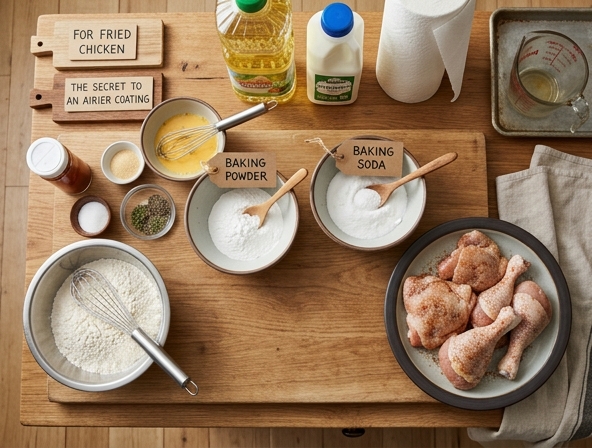
| Ingredient | Role in Fried Chicken | Activation Requirement |
|---|---|---|
| Baking Powder | Acts as a leavening agent to produce a shatter-crisp, airy coating. | Self-activating; no additional ingredients required. |
| Baking Soda | Functions as a chemical leavening agent for texture modification. | Must be paired with an acidic component to activate. |
The Quest for the Ultimate Crunch: Baking Powder vs. Baking Soda in Fried Chicken
Every home cook and professional chef has chased the same holy grail: the perfect piece of fried chicken. We are looking for that elusive, shattered-glass crust-the one that crackles audibly when you bite into it, protecting a succulent, juicy interior. While the quality of the chicken, the temperature of the oil, and the choice of dredging flour all play critical roles, there is a specific culinary secret hidden in the back of the pantry that distinguishes a good crust from a great one: leavening agents.
If you have ever scrolled through culinary forums or watched deep-dive videos on "KFC-style" frying techniques, you have likely encountered a debate involving two ubiquitous white powders: baking soda and baking powder. While they look nearly identical, they behave like polar opposites in the fryer. Understanding the science behind these two agents is the key to unlocking an airier, crispier, and lighter coating that stays crunchy long after the chicken leaves the oil.
The Chemistry of the Crust
To understand why these agents work, we have to look at what they actually do. Both are chemical leaveners, meaning they release carbon dioxide gas when exposed to moisture and heat. In a cake, this creates lift and volume. In fried chicken, this same CO2 release creates tiny bubbles within the flour coating. These bubbles expand in the hot oil, effectively "puffing up" the crust and creating a complex, porous structure that increases surface area-and, by extension, crunch.
Baking Soda: The Culinary Minefield
Baking soda (sodium bicarbonate) is a pure alkaline base. While it is a miracle worker for browning (the Maillard reaction thrives in alkaline environments), it is notoriously difficult to use in a fried chicken dredge. Because it is highly alkaline, it has a distinctively metallic, soapy, and sometimes bitter flavor if used in even slightly excessive amounts.
More importantly, baking soda requires an acidic ingredient to activate fully. Without a significant amount of acid in your buttermilk or marinade to neutralize that alkalinity, you are left with a crust that tastes chemically "off." While some recipes suggest a tiny pinch of baking soda to help the chicken darken, it is a high-risk, low-reward gamble for the average cook. For the pursuit of an airier crust, baking soda is almost always the wrong tool for the job.
Baking Powder: The Secret Weapon
Baking powder is the far superior choice for the deep-fryer. Unlike baking soda, baking powder is a "complete" package; it contains a base (sodium bicarbonate), one or more dry acids (like cream of tartar), and a starch (usually cornstarch) to keep the components from reacting prematurely in the jar.
When you add baking powder to your dry flour mix, it acts as a silent partner in your frying process. When the flour hits the hot oil, the acid and base react instantly to release carbon dioxide. Because the baking powder is encapsulated with starch, it creates a microscopic "honeycomb" structure within the crust. This isn't just about fluffiness-it is about creating thousands of tiny, crunchy chambers that don't absorb as much oil as a denser, traditional flour coating. The result is a crust that is distinctly "airier," lighter on the palate, and stays crisp even as the chicken begins to cool.
How to Implement the Technique
You don't need a lab to pull this off; you just need to adjust your dredging ratio. For every cup of all-purpose flour in your dry mix, add approximately 1 to 1.5 teaspoons of baking powder. It is vital to use aluminum-free baking powder to avoid any metallic aftertaste.
The Strategy:
- Sift Your Drys: Ensure the baking powder is thoroughly incorporated into the flour. Uneven distribution leads to uneven bubbling.
- Double Dredge: Dip the chicken in a liquid (buttermilk or egg wash), then into the flour mix. Press the flour into the meat firmly to create a craggy surface.
- The Rest Period: After dredging, let the chicken sit on a wire rack for about 10–15 minutes before frying. This allows the flour to hydrate and the baking powder to begin its subtle work. This "tackiness" also prevents the breading from sliding off in the fryer.
Common Pitfalls to Avoid
The biggest mistake cooks make is over-relying on leavening agents. Baking powder is an enhancer, not a replacement for proper flour technique. If you add too much, your crust can become brittle or take on a powdery, chalky texture. Stick to the suggested ratio-less is often more.
Furthermore, remember that the "airiness" provided by baking powder only works if the oil is at the correct temperature. Aim for 350°F to 375°F (175°C to 190°C). If the oil is too cool, the crust will absorb the fat before the baking powder has a chance to expand, resulting in a greasy, heavy mess regardless of your leavening agent.
The Final Verdict
If your goal is a fried chicken coating that feels as light as air but shatters with a thunderous crunch, skip the baking soda. It is a temperamental ingredient best left to pretzels and cookies. Instead, embrace the consistent, controlled, and effective power of baking powder. By integrating this simple white powder into your dredging flour, you are fundamentally altering the physics of your crust-transforming it from a dense, floury shell into a delicate, airy structure that defines top-tier fried chicken. Your kitchen, and your guests, will thank you with every crunchy, flavor-packed bite.
Disclaimer:
The information provided on Eateryn is for general educational and informational purposes only and is not intended as medical, nutritional, or healthcare advice. It should not be used to diagnose, treat, cure, or prevent any disease or medical condition.
Always consult a qualified physician, registered dietitian, or other certified healthcare professional before making changes to your diet, exercise routine, or lifestyle, or regarding any medical questions or concerns you may have. Never disregard or delay seeking professional medical advice because of something you have read on this website.