
Bacon vs Salt Pork for Clam Chowder - Identifying The Superior Smoky Base
Achieving the perfect balance of richness in clam chowder often leads chefs to struggle between competing fat sources. While standard recipes traditionally prioritize either bacon or salt pork, the optimal choice remains highly subjective. Proper fat rendering provides essential flavor depth, distinguishing professional-grade results. Note that salt levels and smoke intensity vary significantly; bacon introduces an assertive hickory profile, whereas salt pork yields a clean, foundational richness. This guide evaluates both options to refine your culinary approach.
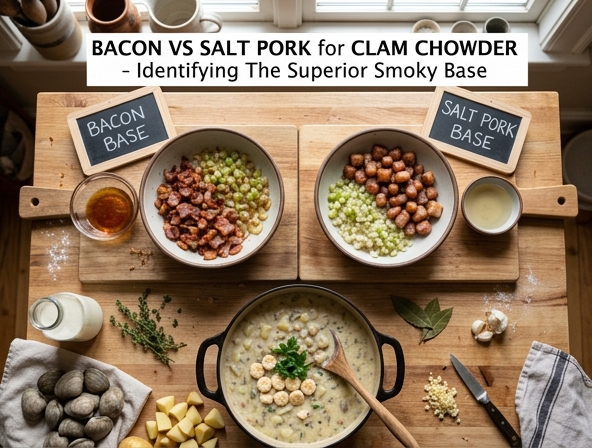
| Ingredient | Flavor Profile | Culinary Impact |
|---|---|---|
| Bacon | Assertive, hickory-forward smoke | Adds a bold, distinct smoky depth to the chowder. |
| Salt Pork | Clean, neutral, and savory | Provides a smooth, foundational richness without overpowering smoke. |
Bacon vs. Salt Pork for Clam Chowder: Identifying the Superior Smoky Base
In the pantheon of comfort foods, few dishes command as much reverence-or spark as much debate-as the classic New England Clam Chowder. While the quality of the clams and the starchiness of the potatoes are undeniably critical, the true foundation of a transcendent chowder lies in its fat. Specifically, the choice between salt pork and bacon serves as the architectural bedrock upon which the soup is built. But which of these porcine staples truly deserves the title of the "superior base"? To answer this, we must look beyond personal preference and examine the chemical, historical, and sensory impacts these ingredients have on the final bowl.
The Case for Tradition: Salt Pork
For purists, salt pork is not just an ingredient; it is a historical mandate. Salt pork is essentially pork belly that has been cured in salt, but crucially, it is not smoked. Historically, this was the primary method for preserving meat on fishing vessels and long-haul expeditions. In the context of clam chowder, salt pork acts as a blank, savory canvas.
When you render salt pork, you are left with a clear, clean lard that carries an intense, unadulterated "porkiness." It provides a luxurious mouthfeel that coats the palate, allowing the sweetness of the clams and the earthiness of the potatoes to shine through without interference. Because it lacks the heavy wood-smoke profile of bacon, salt pork creates a soup that is delicate and elegant. It is the choice for the chef who wants the clam to be the undisputed star of the show.
Mastering the Salt Pork Render
The secret to using salt pork lies in the preparation. Because it is heavily cured, it must be diced into small, uniform lardons. Many chefs recommend a quick blanch in boiling water before browning, which removes excess surface salt and ensures the fat renders evenly without scorching. When fried slowly until golden and crisp, the resulting "cracklings" provide a textural contrast that is deeply satisfying.
The Modern Challenger: Bacon
Bacon, by contrast, brings an assertive, complex flavor profile to the pot. Unlike salt pork, bacon is almost always smoked-usually over hickory, applewood, or maple. In recent decades, bacon has become the default choice for home cooks and many restaurant chefs who want to introduce a "smoky" depth that creates a more robust, "meat-forward" chowder.
The impact of bacon on chowder is transformative. The wood smoke permeates the potatoes and the cream, creating a soup that feels heartier, more rustic, and undeniably punchier. For those who find traditional clam chowder too subtle or one-note, bacon provides the necessary complexity to keep every spoonful interesting. However, there is a catch: the smoke. If you use a heavily smoked commercial bacon, you run the risk of completely masking the delicate, briny essence of the clams. The chowder ceases to be a seafood soup and becomes, for all intents and purposes, a potato-bacon soup with a few clams thrown in for texture.
The Comparison: Fat, Smoke, and Salt
To determine the superior base, we must evaluate three key pillars: fat rendering, flavor impact, and salt balance.
- Fat Rendering: Both ingredients excel at providing the liquid gold necessary to sauté the onions and celery (the chowder's aromatic base). Salt pork generally renders a slightly cleaner fat, whereas bacon fat carries the residual flavor of the smokehouse.
- Flavor Impact: This is the deciding factor for most. Salt pork provides a savory depth that supports the ingredients. Bacon provides a competitive flavor-a smoky high-note that can either enhance the dish or dominate it.
- Salt Balance: This is where caution is required. Salt pork is undeniably salty, but its saltiness is consistent. Bacon, however, varies wildly in sodium content and sugar levels (if maple-cured). A bacon-based chowder requires a much more disciplined hand when it comes to the final seasoning of the soup.
The Verdict: Which is Superior?
The quest for the "superior" base is ultimately subjective, yet it can be categorized by the desired outcome. If your goal is to recreate a bowl that mirrors the traditional, elegant, and light-bodied chowders of 19th-century New England, salt pork is the undisputed champion. It offers a clean, foundational richness that allows the specific quality of your clams to dictate the soup's personality.
Conversely, if your goal is to create a "gourmet" chowder designed to impress a crowd with bold, savory notes-a chowder that stands up well to a cold winter night-bacon is the superior choice. It adds a layers of flavor that can turn a simple lunch into a substantial, filling meal.
A Note for the Experimental Chef
For those who cannot decide, many professional kitchens have found a middle ground: the "cured blend." By using a small amount of high-quality, lightly smoked pancetta (which is unsmoked like salt pork but spiced like bacon), you can achieve a sophisticated balance. Alternatively, use a high-quality salt pork as your base, and finish the bowl with a garnish of crispy, house-cured bacon bits. This technique gives you the clean, oceanic base of tradition while providing that smoky, crispy pop that modern diners crave.
Ultimately, the "superior" base is the one that respects your ingredients. If you have spent good money on fresh, sweet, hand-shucked clams, do not bury them under the weight of heavily smoked bacon. Let the base be a support structure, not a distraction. Whether you choose the austere, salty elegance of pork belly or the smoky, rugged charm of bacon, the beauty of clam chowder remains the same: it is a dish defined by the harmony of its parts.
Disclaimer:
The information provided on Eateryn is for general educational and informational purposes only and is not intended as medical, nutritional, or healthcare advice. It should not be used to diagnose, treat, cure, or prevent any disease or medical condition.
Always consult a qualified physician, registered dietitian, or other certified healthcare professional before making changes to your diet, exercise routine, or lifestyle, or regarding any medical questions or concerns you may have. Never disregard or delay seeking professional medical advice because of something you have read on this website.