
Bacon Bits vs Toasted Walnuts for Macaroni and Cheese - Exploring Savory Texture Profiles
Elevating Macaroni and Cheese Texture
Achieving a balanced mouthfeel in macaroni and cheese is a persistent challenge, as common toppings often fall flat. While standard breadcrumbs are traditional, culinary enthusiasts frequently seek deeper complexity. Selecting the right textural element transforms a basic dish into a refined experience. Note that both additions require precise preparation to complement the sauce's richness. Whether utilizing smoky bacon bits for salinity or toasted walnuts for earthy crunch, this analysis compares how each redefines the classic profile.
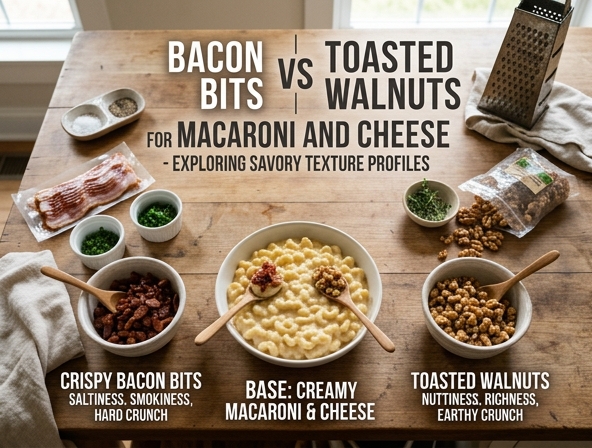
| Addition | Flavor Profile | Texture Contribution | Preparation Requirement |
|---|---|---|---|
| Bacon Bits | Smoky and salty | Crisp and chewy | Requires precise preparation to balance the sauce's richness. |
| Toasted Walnuts | Earthy and nutty | Crunchy | Must be toasted correctly to complement the dish's complexity. |
The Great Textural Debate: Bacon Bits vs. Toasted Walnuts in Macaroni and Cheese
Macaroni and cheese, at its most elemental level, is a masterpiece of uniform softness. It is the culinary equivalent of a warm blanket: a velvety, molten embrace of starch and emulsified dairy. However, as any seasoned home cook or professional chef will attest, a dish defined entirely by creaminess can quickly become one-dimensional. To elevate mac and cheese from a simple comfort food to a sophisticated dining experience, the introduction of a textural counterpoint is not just recommended-it is essential.
Two contenders have risen to the forefront of this culinary debate, each offering a radically different philosophy on how to break up the monotony of the melt. On one side, we have the timeless, indulgent titan: bacon bits. On the other, the modern, earth-bound contender: toasted walnuts. To understand which belongs in your casserole dish, we must explore the interplay of flavor, mouthfeel, and the science of the garnish.
The Case for Bacon: The Umami Anchor
Bacon is the "gold standard" for a reason. Its inclusion in macaroni and cheese is not merely a textural choice; it is a structural flavor decision. When bacon is rendered down to a crisp, it undergoes a transformation that introduces three distinct elements to the bowl: smoke, salt, and fat.
The Texture of the Render: A perfectly cooked bacon bit provides a "shatter-crunch." It is a brittle, aggressive texture that demands attention, cutting through the dense, stringy pull of melted cheddar or Gruyère. Because bacon retains a hint of chewiness at its core, it offers a multi-stage mouthfeel-first the snap of the crisp exterior, then the satisfying resistance of the meat.
The Culinary Impact: Beyond the mechanical crunch, bacon infuses the dish with rendered fat. If you toss your macaroni in a portion of that liquid gold before adding the cheese sauce, the entire profile of the dish shifts. The smokiness lingers on the palate, grounding the otherwise high-fat profile of the cheese. It is an unapologetic, hearty, and primal addition that pairs best with sharp, aged cheddars or robust, funky cheeses like blue or gorgonzola.
The Case for Toasted Walnuts: The Earthy Counterpoint
In contrast to the bold, salt-forward profile of bacon, toasted walnuts offer a more nuanced, cerebral experience. While bacon fights for dominance, walnuts act as a bridge, linking the sweetness of the pasta starch to the sharp acidity of the cheese.
The Science of the Toast: Raw walnuts are often too soft or bitter for a heavy pasta dish. However, when properly toasted-brought to a deep, golden brown in a dry pan until their natural oils are released-they undergo a Maillard reaction that brings out a deep, nutty sweetness. The texture becomes brittle and porous, providing a "clean" snap that vanishes quickly on the tongue.
The Culinary Impact: Walnuts do not compete with the cheese; they refine it. Their inherent earthiness works beautifully with milder, creamier cheeses like Fontina, Taleggio, or even a white cheddar. They add a sophisticated "snap" that feels less heavy than meat. For vegetarian diners or those looking for a lighter, more gourmet profile, the walnut is unmatched. It introduces a subtle bitterness that cleanses the palate, preventing the "boredom" that often sets in halfway through a bowl of heavy pasta.
A Comparative Sensory Analysis
To choose between these two, one must consider the intended "vibe" of the meal. Let's break down the comparative sensory profiles:
- Acoustics: Bacon provides a deeper, lower-frequency crunch. Walnuts provide a sharp, high-frequency "snap."
- Persistence: Bacon remains on the palate long after the swallow due to its fat content. Walnuts provide a fleeting moment of texture that encourages the next bite immediately.
- Fat Integration: Bacon adds to the richness of the cheese sauce. Walnuts contrast against it, providing a dry element that highlights the moistness of the sauce.
- Versatility: Bacon works best in rustic, heavy-duty applications. Walnuts work best in elevated, complex cheese blends that feature herbs like rosemary or sage.
The "Third Way": Finding Harmony
Perhaps the most fascinating conclusion of this exploration is that these two ingredients are not mutually exclusive. When combined, they create a "textural layering" effect. Imagine a mac and cheese topped with a mixture of bacon bits, crushed toasted walnuts, and panko breadcrumbs. The bacon provides the salty base, the walnuts add an earthy middle note, and the breadcrumbs tie it all together with a uniform crunch.
If you are hosting a dinner party and want to impress, this trio of textures is the key. It forces the diner to experience the dish in stages: the initial crunch of the topping, the rich pull of the cheese, and the lingering, savory depth of the bacon-walnut finish.
Final Verdict: Which to Choose?
The choice ultimately rests on your cheese selection and the occasion. If you are building a "stadium-style" mac and cheese-intended for cold nights, hungry crowds, and deep satisfaction-go with the bacon. It is the reliable heavy lifter that ensures no one leaves the table hungry.
If you are crafting a "bistro-style" mac and cheese-served as a small plate, perhaps paired with a glass of crisp white wine or a light salad-choose the toasted walnut. It elevates the dish, turning it into a nuanced study of flavor and texture rather than just a vehicle for dairy consumption.
Whether you choose the smoky intensity of the pig or the earthy elegance of the nut, remember the most important rule of mac and cheese: texture is not an afterthought. It is the finishing touch that transforms a bowl of pasta into a conversation piece. Experiment, toast your nuts with care, render your bacon until it's just on the edge of perfection, and above all, embrace the crunch.
Disclaimer:
The information provided on Eateryn is for general educational and informational purposes only and is not intended as medical, nutritional, or healthcare advice. It should not be used to diagnose, treat, cure, or prevent any disease or medical condition.
Always consult a qualified physician, registered dietitian, or other certified healthcare professional before making changes to your diet, exercise routine, or lifestyle, or regarding any medical questions or concerns you may have. Never disregard or delay seeking professional medical advice because of something you have read on this website.