
Asiago vs Cheddar for Bagel - Comparing savory cheese toppings
Asiago vs. Cheddar: Elevating Your Bagel Offerings
Many bakers struggle to distinguish their bagel selection from standard, unremarkable offerings. While sesame or plain seeds remain industry staples, they often lack the depth required for a premium sensory experience. Integrating robust cheeses transforms a simple carbohydrate into a gourmet centerpiece. Note that melt temperature and fat content significantly impact the final texture. Asiago provides a sharp, nutty profile, while Cheddar offers a rich, creamy finish. This analysis evaluates their distinct characteristics to determine the ideal application.
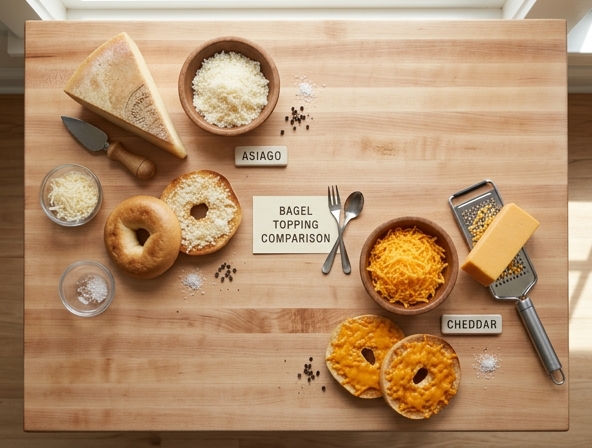
| Feature | Asiago | Cheddar |
|---|---|---|
| Flavor Profile | Sharp and nutty | Rich and creamy |
| Sensory Impact | Adds depth and complexity | Provides a smooth, savory finish |
| Ideal Application | Premium gourmet centerpieces | Classic, comfort-focused bagels |
| Technical Note | Varies in melt and fat content | Varies in melt and fat content |
The Ultimate Bagel Showdown: Asiago vs. Cheddar
For the bagel enthusiast, the debate over toppings is as fundamental as the choice between water-boiled or steam-baked. While sesame, poppy seed, and everything seasoning hold their ground, cheese bagels occupy a category of their own: the savory, indulgent, golden-brown tier. When it comes to crowning the king of bagel toppings, two titans emerge from the dairy aisle: the sophisticated, nutty Asiago and the bold, nostalgic Cheddar. But which one deserves the heat of your oven? Let's break down the science, the flavor profiles, and the culinary utility of these two heavyweights.
The Case for Asiago: The Artisanal Crust
Asiago is, in many ways, the refined cousin of the bagel cheese family. Originating from the Veneto region of Italy, this cow's milk cheese undergoes a transformation when exposed to high heat that few other varieties can replicate. Unlike softer cheeses that simply melt into a puddle, Asiago-particularly the aged variety-possesses a lower moisture content and a crystalline, granular structure that makes it perfect for a "crust" topping.
When you top a bagel with shredded Asiago, you aren't just adding flavor; you are adding texture. As the bagel bakes, the cheese doesn't just melt-it caramelizes. The edges of the cheese shreds crisp up, creating those sought-after brown, lacy bits that provide a satisfying "crunch-snap" upon the first bite. Its flavor profile is distinctly nutty, slightly fruity, and sharp enough to cut through the density of a chewy bagel. For those who prefer a "baked-in" or "baked-on" experience where the cheese becomes part of the bagel's exterior architecture, Asiago is the undisputed champion.
The Case for Cheddar: The Comfort King
If Asiago is the elegant, refined choice, Cheddar is the undisputed king of comfort. Cheddar is familiar, reliable, and profoundly satisfying. Depending on the age of the cheddar, the experience can range from a mild, creamy melt to a sharp, tangy punch. Unlike the rigid structure of Asiago, cheddar is a high-fat, high-moisture cheese that turns into a luxurious, molten blanket when heated.
Cheddar's strength lies in its "gooey" factor. If your goal for your bagel is to create a breakfast melt-perhaps with a slice of tomato or a fried egg-Cheddar is your best friend. It bridges the gap between the bread and the filling, binding ingredients together with its silky texture. Furthermore, the aesthetic appeal of a deeply orange or sharp white cheddar bubbling over the edges of a hot bagel is the height of culinary comfort. It's nostalgic, it's approachable, and it pairs perfectly with almost any other savory ingredient, from bacon to scallions.
Technical Comparison: Melting Points and Moisture
To understand why these two cheeses perform differently on a bagel, we have to look at their composition. Asiago is a semi-hard to hard cheese. Because it has less moisture, it is less prone to "sweating" oil when heated. This allows it to hold its shape during the bake, creating that signature crust. It maintains its integrity even under the intense dry heat of a bagel oven or toaster oven.
Cheddar, conversely, is a semi-hard cheese that is notoriously prone to "oil separation" if overcooked. If you leave a cheddar-topped bagel in the oven too long, the fat separates from the protein, leaving you with a slightly oily, greasy pool rather than a luscious melt. For the best results with cheddar, it is often better to apply the cheese in the final minutes of the toasting process, or to use a sharp, aged cheddar which contains slightly less moisture than a young, mild version.
Pairing Potential: What Goes Best?
When deciding between the two, consider the bagel's purpose:
- Choose Asiago if: You are eating the bagel on its own, with a simple smear of cream cheese, or as a side to a bowl of soup. Its robust, nutty notes stand alone beautifully and don't need additional embellishment to shine. It is the perfect topping for a rosemary or garlic-infused bagel.
- Choose Cheddar if: You are building a sandwich. Cheddar is the ultimate team player. It pairs perfectly with ham, turkey, breakfast sausage, or even sliced green apples. If you are adding layers of flavor, Cheddar will enhance the profile without overpowering the other ingredients.
Expert Tips for the Perfect Cheese Bagel
Regardless of your choice, the execution is key. Here are three tips to ensure your cheese bagel reaches its full potential:
- The Shred Matters: Always use a box grater to hand-shred your cheese. Pre-shredded bagged cheese is coated in cellulose (an anti-caking agent) which inhibits the cheese's ability to melt properly, leading to a dry, floury texture.
- Temperature Control: For Asiago, place the cheese on the bagel before it goes into the oven to ensure that perfect, caramelized crust. For Cheddar, wait until the bagel is toasted, then sprinkle the cheese and return it to the heat just long enough for it to bubble and soften.
- The Blend Strategy: Why choose? Some of the best bagel shops utilize a blend. Use a base of mozzarella for the "melt" and a top layer of Asiago for the "crust." This gives you the best of both worlds: a gooey interior and a crispy, nutty exterior.
Conclusion: The Verdict
So, which is superior? There is no objective winner, only a context-dependent champion. If you prioritize the integrity of the bagel itself-looking for a snack that provides a sophisticated flavor and a textural contrast-Asiago is the choice for you. It elevates the humble bagel into an artisanal bread product.
If, however, your bagel is a vessel for a substantial breakfast meal-a base for protein, veggies, and savory heat-Cheddar is the better companion. It offers a warmth and richness that completes the meal, providing that classic comfort-food satisfaction that has made it a staple in kitchens for generations.
Ultimately, the beauty of the bagel lies in its versatility. Whether you prefer the sharp, crystalline crunch of an aged Asiago or the molten, tangy indulgence of a sharp Cheddar, the most important rule is to use high-quality, freshly grated cheese. Your breakfast is only as good as the ingredients you put into it, so don't be afraid to experiment, blend, and find the perfect balance that satisfies your own palate.
Disclaimer:
The information provided on Eateryn is for general educational and informational purposes only and is not intended as medical, nutritional, or healthcare advice. It should not be used to diagnose, treat, cure, or prevent any disease or medical condition.
Always consult a qualified physician, registered dietitian, or other certified healthcare professional before making changes to your diet, exercise routine, or lifestyle, or regarding any medical questions or concerns you may have. Never disregard or delay seeking professional medical advice because of something you have read on this website.