
Artisan Flour vs All-Purpose Flour for Pizza - The Science of Dough Elasticity
Artisan Flour vs. All-Purpose Flour for Pizza
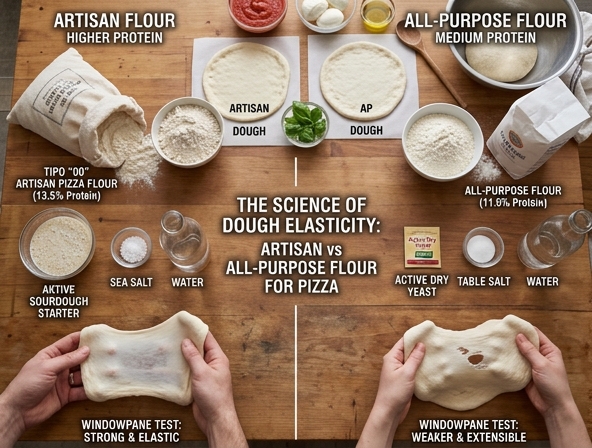
Home bakers often struggle with dough that lacks the structural integrity required for a perfect crust. While standard all-purpose flour is a kitchen staple, its limited protein content frequently fails to support optimal elasticity. Conversely, artisan options like Tipo 00 grant the dough a robust gluten network. Although flour selection alone doesn't guarantee excellence, understanding protein dynamics is essential. The following guide details how these specific characteristics influence elasticity and overall crust development.
| Flour Type | Protein Characteristics | Impact on Dough/Crust |
|---|---|---|
| All-Purpose Flour | Limited protein content | Often fails to provide the structural integrity required for optimal elasticity. |
| Artisan Flour (e.g., Tipo 00) | Higher, specialized protein | Facilitates a robust gluten network for superior crust development. |
| Summary: Flour selection is a critical factor in pizza making; understanding protein dynamics is essential for home bakers to achieve the desired dough elasticity. | ||
Artisan Flour vs. All-Purpose Flour for Pizza: The Science of Dough Elasticity
For the home pizza enthusiast, the journey toward the perfect crust often begins with a simple question: Does the type of flour really matter? While many amateur bakers start with a bag of standard all-purpose flour from the grocery store, a transition to specialized "artisan" or "00" flour often marks the threshold of true pizza mastery. But beyond the marketing buzz and the price tag, what is actually happening at a molecular level that differentiates these flours? The answer lies in the complex, rhythmic interplay of protein composition, hydration, and the structural science of dough elasticity.
The Molecular Foundation: Protein and Gluten
To understand the difference between flour types, we must first define the building blocks of dough. Wheat flour is composed primarily of starch and protein. When water is added, two specific proteins-glutenin and gliadin-begin to bond, forming a complex network known as gluten. This network acts as the skeleton of your pizza crust, trapping the carbon dioxide gases produced by yeast during fermentation.
The distinction between flours is largely determined by the quantity and quality of these proteins. All-purpose (AP) flour typically contains between 9% and 11% protein. It is designed to be a "jack-of-all-trades," suitable for cookies, cakes, and quick breads where a delicate crumb is preferred over structural tension. In contrast, artisan or pizza-specific flours (often labeled "00" or high-protein bread flour) generally range from 12% to 14% protein. This higher protein content provides more "raw material" to build a stronger, more resilient gluten network.
Elasticity vs. Extensibility: The Pizzaiolo's Balancing Act
In the world of dough, two concepts are paramount: elasticity and extensibility. Elasticity is the dough's ability to snap back to its original shape, while extensibility is its ability to stretch without tearing. A pizza crust requires a delicate equilibrium between the two.
When you use all-purpose flour, you are working with a weaker gluten network. Because the protein content is lower, the bonds between glutenin and gliadin are less dense. This results in a dough that is highly extensible but lacks the structural integrity to withstand long fermentation times or high-temperature ovens. If you try to stretch an AP flour dough too thin, the lack of elasticity often leads to "thin spots" or premature tearing. Conversely, if you work it too much, it may become overly sticky, as the starch content relative to protein is higher.
Artisan flour, however, is engineered for resilience. The higher protein percentage creates a more robust gluten matrix. This provides the "snap-back" needed to hold the air bubbles produced by yeast, ensuring a crust that is airy, light, and structured. It allows the dough to be stretched paper-thin without collapsing, a requirement for traditional Neapolitan-style pizzas.
The Role of Fermentation
The science of dough elasticity cannot be separated from the science of fermentation. The breakdown of starches into simple sugars by yeast, and the subsequent production of gas, is a process that takes time. All-purpose flour generally cannot handle long fermentation cycles (such as 24 to 72 hours in the refrigerator). Over such long periods, the weaker gluten structure of AP flour begins to break down-a process known as proteolysis. The dough becomes slack, loses its elasticity, and eventually becomes impossible to shape.
Artisan flours, often milled from "hard" wheat varieties, are specifically designed to withstand the enzymatic activity that occurs during long cold-fermentations. This longevity allows for the development of complex, fermented flavors and the characteristic "leopard-spotting" (charring) that occurs in high-heat ovens. With artisan flour, the longer you ferment, the more you refine the texture of the crust, whereas with AP flour, you are often racing against the clock before the structural integrity fails.
The Milling Process: The "00" Distinction
While protein quantity is vital, the "00" label found on many artisan pizza flours refers to the milling grade. In Italy, flours are graded by how finely they are ground. A "00" flour is milled to a powder-like consistency, removing most of the bran and germ. This superfine grind allows for faster hydration of the flour particles. When water meets the flour, the gluten network begins to form almost immediately and more uniformly throughout the mass. This creates a dough that feels velvety and supple, rather than the slightly granular feel of standard bleached all-purpose flours.
Practical Application: When to Use Which?
Does this mean you should discard your all-purpose flour? Not necessarily. The choice depends on the style of pizza you are aiming for:
- Choose All-Purpose Flour if: You are making a "New York Style" slice or a thicker, pan-style pizza where a soft, tender crumb is desired. AP flour works excellently for shorter fermentation times (4–8 hours) and lower-temperature ovens, where a crisp-but-chewy texture is the goal.
- Choose Artisan/00 Flour if: You are aiming for a traditional Neapolitan crust, characterized by an airy, puffed-up "cornicione" (rim) and a thin, crispy-yet-pliable center. If you plan on a cold ferment longer than 24 hours, the high-protein content of artisan flour is essentially non-negotiable for success.
Conclusion: The Verdict
The science of dough elasticity is a matter of managing your protein network. All-purpose flour is a gentle, forgiving workhorse for simple, quick-turnaround bakes, but it lacks the tensile strength required for advanced pizza techniques. Artisan flour is a specialized tool that rewards the baker's patience. By providing the structural foundation necessary for long fermentation and high-heat expansion, artisan flour allows the home baker to transcend the limitations of standard kitchen staples. Whether you are chasing the perfect bubble or the perfect stretch, understanding the chemistry of your flour is the first step toward achieving a truly professional pizza in your own kitchen.
Disclaimer:
The information provided on Eateryn is for general educational and informational purposes only and is not intended as medical, nutritional, or healthcare advice. It should not be used to diagnose, treat, cure, or prevent any disease or medical condition.
Always consult a qualified physician, registered dietitian, or other certified healthcare professional before making changes to your diet, exercise routine, or lifestyle, or regarding any medical questions or concerns you may have. Never disregard or delay seeking professional medical advice because of something you have read on this website.