
American Cheese vs Provolone for Grilled Cheese Sandwich - Evaluating Meltability And Stretch
Achieving the perfect grilled cheese often results in uneven melting or rubbery textures. While standard staples like Cheddar provide reliable flavor, they lack the specialized thermal properties required for a premium sandwich. Understanding these variables grants you complete mastery over your final result. Note that meltability and stretch typically function inversely; you must balance creaminess against resistance. We will now analyze American cheese's emulsified consistency versus Provolone's stringy pull to determine which best suits your objectives.
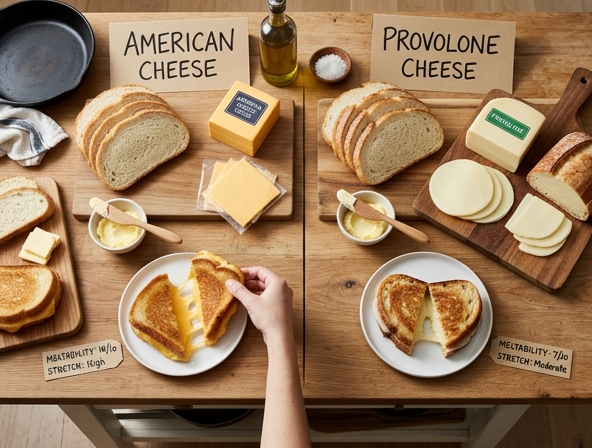
| Feature | American Cheese | Provolone |
|---|---|---|
| Consistency | Emulsified and creamy | Stringy and resistant |
| Meltability | High | Moderate |
| Stretch | Low | High |
| Key Characteristic | Superior melting properties | Pronounced "pull" or texture |
The Ultimate Grilled Cheese Showdown: American vs. Provolone
The grilled cheese sandwich is a cornerstone of comfort food-a minimalist masterpiece of bread, fat, and melted dairy. While the construction seems straightforward, the choice of cheese acts as the soul of the sandwich. For decades, the debate has raged between the nostalgic, unparalleled melt of processed American cheese and the sophisticated, elastic pull of Provolone. But which one truly reigns supreme when subjected to the heat of the skillet? To find out, we must dive into the science of meltability, the mechanics of the "cheese pull," and the nuanced interplay of flavor profiles.
The American Cheese Phenomenon: Engineering the Perfect Melt
To understand American cheese, we have to look past the culinary snobbery often directed at it. American cheese is a marvel of food science. Unlike natural cheeses, which are composed of proteins, fats, and water held together in a fragile lattice, American cheese is produced by blending natural cheese with emulsifying salts-most commonly sodium citrate.
When you heat a natural cheese, the fats begin to separate from the proteins, often resulting in a greasy, clumpy mess. The emulsifiers in American cheese prevent this separation, keeping the proteins and fats suspended in a stable, homogeneous emulsion. The result is the holy grail of grilled cheese: a velvet-smooth, perfectly consistent flow that covers every square inch of the bread. From a purely functional standpoint, American cheese is the gold standard for meltability. It requires minimal heat to reach its peak consistency, meaning your bread is far less likely to burn while waiting for the center to liquefy.
Provolone: The Elastic Contender
Provolone, a semi-hard Italian cheese, offers a completely different sensory experience. It is a pasta filata (stretched curd) cheese, related to mozzarella, but allowed to age. This aging process changes the protein structure of the cheese, granting it a distinct elasticity that American cheese simply cannot replicate.
When you bite into a grilled cheese made with Provolone, you aren't just looking for a creamy texture; you are looking for that dramatic, long-distance cheese pull. Provolone's high protein content gives it a "chew" that provides structural integrity to the sandwich. While it is more prone to oiling out-where the fats pool if the cheese is heated too quickly or unevenly-it offers a depth of flavor that American cheese lacks. Depending on whether you choose mild or piccante (aged) Provolone, you can expect anything from a buttery, gentle tang to a sharp, spicy finish that cuts through the richness of the buttered bread.
The Evaluation: Meltability vs. Stretch
To determine the winner, we evaluated these two contenders across three primary metrics:
- Consistency: American cheese provides a uniform, creamy blanket. Provolone provides a stringy, tactile experience.
- Structural Integrity: Provolone holds its shape better, which is helpful if you are adding heavy ingredients like ham or tomato. American cheese is essentially liquid gold and can cause a sandwich to slide apart if overloaded.
- Flavor Complexity: Provolone wins this category by a landslide. American cheese is primarily salt and creaminess; Provolone carries the terroir of the milk and the character of the aging process.
| Feature | American Cheese | Provolone |
|---|---|---|
| Meltability | Exceptional (Smooth) | Good (Elastic) |
| Stretch | Low | High |
| Flavor Profile | Mild, Salty | Buttery to Sharp |
| Difficulty to Cook | Very Low | Moderate |
The Science of the Browning
A crucial factor in any grilled cheese is the temperature management. American cheese melts at a much lower temperature than Provolone. If you are using a thick-cut sourdough bread, you need a cheese that will melt before the bread scorches. American cheese is forgiving; it melts quickly, allowing you to focus on achieving that perfect golden-brown crust on the bread. Provolone, being a bit more stubborn, often requires a slightly slower cook-perhaps a covered skillet or a lower heat setting-to ensure the center is molten without burning the exterior.
The Verdict: A Matter of Intention
So, which is the victor? The answer depends entirely on what you want from your meal.
If you are craving pure, unadulterated comfort-the kind that reminds you of childhood lunches-American cheese is unbeatable. Its ability to create a smooth, homogenous sauce between two slices of white bread is a testament to its design. It creates the iconic, classic grilled cheese that feels like a warm hug.
However, if you are looking to elevate your sandwich to a more culinary level, Provolone is the superior choice. It offers the resistance, the stretch, and the nuanced flavor profile that transforms a sandwich from a snack into a meal. The "pull" of the cheese is an essential part of the eating experience, providing a tactile satisfaction that processed cheese simply cannot provide.
The "Pro" Compromise
Why choose one when you can harness the strengths of both? Many professional chefs use a "blend" approach. By using one slice of American cheese to serve as the emulsifier-ensuring everything melts perfectly and stays together-and layering it with a slice of high-quality, aged Provolone, you get the best of both worlds. You achieve the perfect melt and the incredible stretch, combined with a depth of flavor that satisfies the palate.
In the end, whether you choose the nostalgic ease of American or the sophisticated stretch of Provolone, the key to a perfect grilled cheese remains the same: use plenty of butter, take your time with the heat, and never be afraid to experiment. Happy grilling!
Disclaimer:
The information provided on Eateryn is for general educational and informational purposes only and is not intended as medical, nutritional, or healthcare advice. It should not be used to diagnose, treat, cure, or prevent any disease or medical condition.
Always consult a qualified physician, registered dietitian, or other certified healthcare professional before making changes to your diet, exercise routine, or lifestyle, or regarding any medical questions or concerns you may have. Never disregard or delay seeking professional medical advice because of something you have read on this website.