
Air Fryer vs Traditional Oven for Macaroni and Cheese - Speed Versus Even Browning
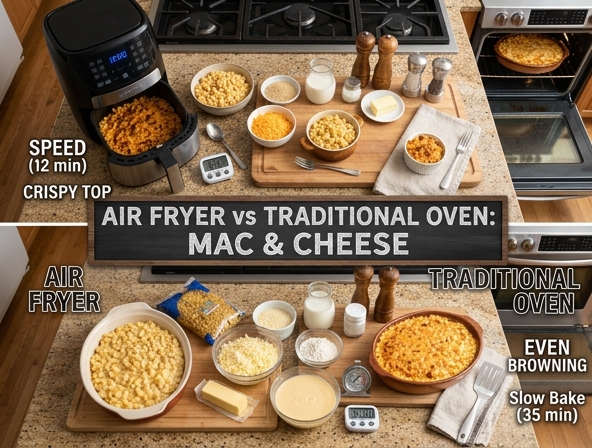
| Feature | Traditional Oven | Air Fryer |
|---|---|---|
| Cooking Speed | Standard; slower cooking process. | Accelerated; rapid convection heat. |
| Heat Distribution | Consistent and uniform throughout the dish. | Intense, direct airflow for fast browning. |
| Vessel Size | Accommodates standard baking dishes. | Requires smaller vessels to ensure proper airflow. |
| Primary Trade-off | Reliability vs. longer time. | Speed/Browning vs. risk of uneven texture. |
| Best For | Large batches requiring uniform texture. | Efficiency and achieving a crisp crust quickly. |
The Ultimate Comfort Food Battle: Air Fryer vs. Traditional Oven for Macaroni and Cheese
Macaroni and cheese is the quintessential comfort food. It is a dish defined by its alchemy: the marriage of starch, emulsified fats, and melted proteins. While the base recipe-a silky Mornay sauce tossed with al dente pasta-is consistent, the final stage of cooking is where the culinary philosophy diverges. For decades, the traditional oven has been the undisputed hearth for baking mac and cheese to bubbling, golden perfection. However, the rise of the air fryer has introduced a provocative challenger to the kitchen counter.
Is the air fryer a legitimate contender, or does it merely provide a shortcut that sacrifices the soulful texture of a classic baked casserole? To settle the score, we must examine the intersection of thermodynamics, Maillard reaction kinetics, and practical kitchen utility.
The Traditional Oven: The Gentle Giant of Thermal Equilibrium
The traditional oven operates primarily through thermal radiation and natural convection. When you slide a heavy stoneware or glass baking dish filled with mac and cheese into an oven preheated to 375°F (190°C), you are engaging in a process of slow, deep heat penetration. The oven does not merely brown the top; it gently warms the entire mass of the dish from the outside in.
The Advantages of the Oven:
- Capacity: If you are feeding a family or hosting a dinner party, the oven remains the gold standard. A 9x13-inch pan provides enough surface area for a family-sized serving, ensuring that the middle stays creamy while the edges develop a delightful, chewy "crust."
- Even Browning: Because of the ambient heat, the browning process-where the proteins and sugars in the cheese and breadcrumbs undergo the Maillard reaction-is gradual and uniform. This leads to a rich, complex golden-brown color rather than a burnt or dehydrated one.
- Texture Consistency: The oven provides a slow bake that allows the sauce to thicken properly around the pasta, creating a cohesive, velvety mouthfeel that is the hallmark of a high-quality bake.
The Air Fryer: The Convection Powerhouse
Despite its marketing name, an air fryer is essentially a high-velocity countertop convection oven. Its primary feature is a powerful heating element coupled with a robust fan that circulates hot air at a very high speed. This creates a high-pressure environment that strips away moisture rapidly, which is excellent for crisping but presents specific challenges for a pasta dish.
The Advantages of the Air Fryer:
- Speed: The most significant benefit is time. An air fryer can achieve a crispy top in roughly 5 to 10 minutes, compared to the 20 to 30 minutes required in a traditional oven. For a quick weeknight craving, it is unparalleled.
- Focused Heat: Because the air is constantly moving, the top layer of cheese and breadcrumbs is subjected to intense, concentrated heat. This creates an incredibly crunchy, "fried" texture that many enthusiasts find superior to a standard breadcrumb topping.
- Efficiency: In the summer, turning on a full-sized oven can raise the temperature of your entire kitchen. The air fryer remains contained, making it an ideal choice for smaller, individual-sized portions of mac and cheese without heating the entire house.
The Comparison: Speed Versus Even Browning
The central tension here is between the "long and slow" approach and the "fast and fierce" approach. When we talk about mac and cheese, "evenness" is usually the goal. A traditional oven produces a gentle gradient of texture-the crispy top, the slightly firmer sides, and the soft, molten center.
In contrast, the air fryer is a "surface-dominant" tool. Because the fan blows air directly onto the top of the dish, the surface will brown, char, or crisp long before the internal temperature of the pasta reaches the desired state. If you aren't careful, you end up with a layer of scorched cheese atop lukewarm, dry pasta. To succeed in an air fryer, one must use lower temperatures and shorter bursts, often shielding the top with foil for the first few minutes, which complicates the "speed" advantage significantly.
Practical Tips for Success
For the Traditional Oven: To maximize the crust without drying out the center, avoid overcooking the pasta before it goes into the oven. Boil it to "just shy" of al dente; the pasta will finish absorbing moisture from the cheese sauce during the bake. Sprinkle a mixture of panko breadcrumbs and grated Parmesan on top, and dot with small cubes of butter to encourage deep, even browning.
For the Air Fryer: Stick to individual ramekins or shallow, small baking tins. Do not crowd the air fryer basket, as airflow is the mechanism of success. Lower your heat setting-aim for 325°F (160°C)-to allow the heat to penetrate the center of the ramekin without incinerating the cheese layer on top. If the top browns too quickly, cover it with a small square of parchment paper or foil, removing it for the final 60 seconds to achieve that perfect crunch.
Conclusion: The Verdict
Choosing between the two depends entirely on your context. If your priority is a large-batch, crowd-pleasing casserole where the texture is uniform, elegant, and nostalgic, the traditional oven is the undisputed champion. It allows for the slow development of flavors and the structural integrity that makes baked mac and cheese a culinary classic.
However, if you are a solo diner or a pair looking for a quick, crispy, and highly satisfying individual portion of mac and cheese, the air fryer is an incredible tool. It excels at delivering that "crispy edge" experience that many people pick off the sides of a standard baking dish anyway. Ultimately, the best results often come from knowing the limitations of your machine and adjusting your technique to suit its temperament.
Whether you choose the slow-and-steady route of the oven or the high-velocity punch of the air fryer, the success of the dish remains in the quality of your cheese and the patience you exercise in your assembly. In the world of comfort food, there is rarely a wrong way to brown cheese-only different paths to the same gooey, golden reward.
Disclaimer:
The information provided on Eateryn is for general educational and informational purposes only and is not intended as medical, nutritional, or healthcare advice. It should not be used to diagnose, treat, cure, or prevent any disease or medical condition.
Always consult a qualified physician, registered dietitian, or other certified healthcare professional before making changes to your diet, exercise routine, or lifestyle, or regarding any medical questions or concerns you may have. Never disregard or delay seeking professional medical advice because of something you have read on this website.