
Air Fryer vs Stovetop for Grilled Cheese Sandwich - Modern Convenience Versus Traditional Technique
Achieving the perfect grilled cheese often results in uneven browning or under-melted centers, a frequent frustration for home cooks. While the traditional stovetop method demands constant vigilance and butter-to-heat precision, the air fryer offers a modern, hands-off alternative. Note that results depend heavily on your specific appliance's wattage. Whether you prioritize a classic buttery crust or efficient, consistent crispness, both techniques yield excellent results. We will now compare these methods to refine your culinary approach.
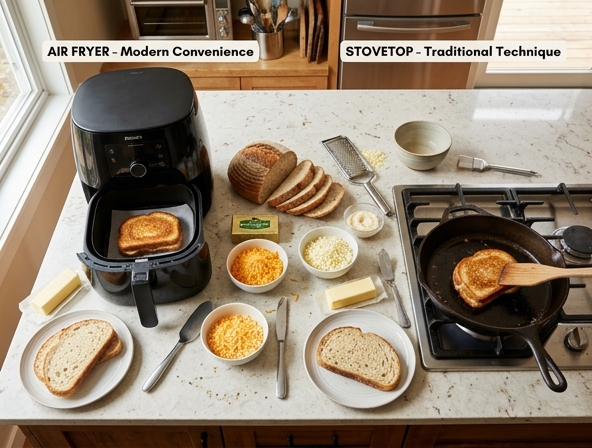
| Method | Key Characteristics | Primary Requirement |
|---|---|---|
| Stovetop | Achieves a classic, buttery crust; traditional approach. | Demands constant vigilance and precise butter-to-heat control. |
| Air Fryer | Offers a modern, hands-off experience; provides consistent crispness. | Results are heavily dependent on the appliance's specific wattage. |
The Golden Standard: Air Fryer vs. Stovetop for the Ultimate Grilled Cheese
The grilled cheese sandwich is perhaps the most iconic comfort food in the culinary canon. It is a masterpiece of simplicity: two slices of bread, a generous layer of cheese, and the transformative power of heat and fat. Yet, despite its humble nature, the debate over the "perfect" preparation method is fierce. In one corner stands the traditionalist, armed with a cast-iron skillet and a pat of salted butter; in the other stands the modern home cook, utilizing the high-speed convection currents of an air fryer.
As kitchen technology evolves, the battle between "modern convenience" and "traditional technique" has reached the sandwich plate. Does the air fryer truly provide a superior crisp, or does it lose the soul of the dish in its attempt to modernize a classic?
The Traditionalist's Path: The Art of the Stovetop
For purists, the stovetop method is not just a cooking process; it is a ritual. The stovetop offers a tactile, sensory experience that no appliance can replicate. When you place a buttered slice of bread into a hot skillet, you hear the immediate "hiss" of fat hitting metal. You see the color change in real-time, allowing for micro-adjustments in temperature to ensure the bread achieves that deep, mahogany-gold crust without burning.
The secret to the stovetop method is the Maillard reaction-the chemical reaction between amino acids and reducing sugars that gives browned food its distinctive flavor. By manually controlling the heat, the stovetop allows the cheese to melt in perfect synchronization with the toasting of the bread. The pressure of a spatula also creates a specific, compressed density that is characteristic of a classic diner-style grilled cheese.
However, the stovetop is not without its pitfalls. It requires your undivided attention. A moment of distraction, or a pan that is slightly too hot, leads to "burnt exterior, cold interior" syndrome. It demands patience, technique, and the willingness to flip at the exact right second to ensure even browning on both sides.
The Modern Challenger: Efficiency and Consistency
Enter the air fryer-the countertop convection powerhouse that has revolutionized quick meals. An air fryer is essentially a high-powered fan that circulates scorching hot air around the food. In the context of a grilled cheese, this creates a uniform crispness that is nearly impossible to achieve on a stove. Because the heat hits the bread from all angles simultaneously, you never have to worry about flipping your sandwich or dealing with the "doughy center" that can sometimes plague the stovetop method.
The primary advantage of the air fryer is its consistency and lack of supervision. You set the temperature-typically 350°F to 375°F-and a timer for five to seven minutes. There is no risk of the bread absorbing excess butter, as the air fryer allows the fat to drip away rather than pool in a pan. For those who find the stovetop process tedious or anxiety-inducing, the air fryer offers a "set-it-and-forget-it" liberation.
However, there are detractors. Some argue that air-fried bread lacks the "buttery" richness of a pan-seared sandwich. While you can brush butter on the exterior, the air fryer tends to dry out the bread slightly, creating a crunch that is more "toast-like" than "pan-fried."
Comparing the Results: Texture and Melt
When comparing the two, it is important to categorize what exactly makes a grilled cheese "great."
- The Crust: Stovetop provides a rich, buttery, caramelized crunch. The air fryer provides a clean, dry, and consistently crispy texture. If you prefer a sandwich that feels decadent, the pan is your champion. If you prefer a crunch that is light and shatteringly crisp, the air fryer wins.
- The Melt: Stovetop cooking often requires a lid to encourage the cheese to melt before the bread burns. The air fryer naturally melts the cheese evenly throughout because the interior heat is so high, making it excellent for thick-cut cheeses or sourdough loaves that require longer cooking times.
- Cleanup: The air fryer wins on convenience, provided you use parchment paper or a silicone liner. The stovetop leaves you with a greasy pan and potentially a butter-splattered stovetop to wipe down.
The Verdict: Which Should You Choose?
The choice between stovetop and air fryer ultimately comes down to your priorities in the kitchen. If you are preparing a grilled cheese as a therapeutic Sunday afternoon meal-complete with a bowl of tomato soup-the stovetop is the only way to go. The process is a part of the pleasure, and the buttery, golden-brown finish of a skillet-grilled sandwich remains the gold standard of comfort food.
Conversely, if you are looking for a reliable, fast, and consistent weekday lunch, the air fryer is a game-changer. It is perfect for those who want a quality sandwich without standing over a stove, particularly if you are experimenting with adding extras like bacon, thick tomato slices, or multiple varieties of cheese that need a little extra time to melt properly.
Perhaps the best approach is to stop viewing these as competing methods and start seeing them as different tools in a culinary toolkit. A true grilled cheese enthusiast learns to master the skillet for the nostalgia and the air fryer for the utility. Regardless of the method, the core of the sandwich remains the same: a simple, perfect marriage of bread, cheese, and heat. Whether it is kissed by butter in a pan or swirled in a convection gale, a well-made grilled cheese remains, forever, one of the world's most satisfying bites.
Disclaimer:
The information provided on Eateryn is for general educational and informational purposes only and is not intended as medical, nutritional, or healthcare advice. It should not be used to diagnose, treat, cure, or prevent any disease or medical condition.
Always consult a qualified physician, registered dietitian, or other certified healthcare professional before making changes to your diet, exercise routine, or lifestyle, or regarding any medical questions or concerns you may have. Never disregard or delay seeking professional medical advice because of something you have read on this website.