
Air Fryer vs Deep Fryer for Fried Chicken - Achieving The Perfect Texture
Air Fryer vs. Deep Fryer: Achieving Perfection
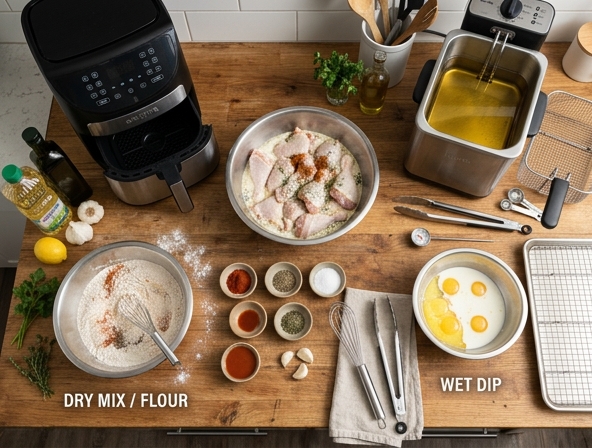
Achieving restaurant-quality crispness without excessive oil saturation remains a common culinary challenge. While deep frying sets the industry benchmark for texture, modern cooks often weigh the benefits of air-frying alternatives. Understanding your appliance's mechanics grants you absolute control over moisture and heat distribution. Note: final results rely heavily on your specific breading technique. While deep fryers offer uniform golden-brown crusts, air fryers provide undeniable lightness. We will examine these methods to optimize your chicken's texture.
| Feature | Deep Fryer | Air Fryer |
|---|---|---|
| Texture | Industry benchmark; creates a uniform, golden-brown crust. | Undeniably lighter finish. |
| Oil Usage | Higher oil saturation. | Lower oil usage; healthier alternative. |
| Critical Factors | Requires control over heat distribution and specific breading. | Requires understanding of appliance mechanics and specific breading. |
| Culinary Goal | Restaurant-quality crispness. | Crispness without excessive oil. |
Air Fryer vs. Deep Fryer: The Battle for the Ultimate Fried Chicken
For many, fried chicken is the pinnacle of comfort food. It represents the perfect culinary intersection of a shatteringly crisp exterior and succulent, tender meat within. But when it comes to achieving that iconic texture, a long-standing debate persists in home kitchens: the traditional deep fryer versus the modern, trendy air fryer. Is it possible to replicate the golden, deep-fried crunch using rapid hot air, or does the submersion in bubbling oil remain the only true path to perfection?
The Science of the Fry: Heat and Moisture
To understand the difference, we must first look at the science. Deep frying is a process of dehydration and rapid heat transfer. When chicken is submerged in oil heated to roughly 350°F (175°C), the moisture on the surface of the breading vaporizes instantly, creating a barrier that prevents excess oil from soaking into the meat while simultaneously creating a rigid, golden-brown crust through the Maillard reaction. This reaction-the chemical change between amino acids and reducing sugars-is responsible for the complex, savory flavors we associate with "fried" food.
Air frying, by contrast, is essentially convection cooking on steroids. An air fryer uses a powerful fan to circulate hot air at high speeds around the food. While it mimics the crispiness of deep frying, it lacks the conductive intensity of oil. The texture achieved is lighter and drier, but because it lacks that immediate lipid-based heat transfer, it can sometimes struggle to create the same depth of flavor and structural integrity in the crust.
The Deep Fryer: The Gold Standard of Texture
For purists, nothing will ever replace the deep fryer. When you drop a buttermilk-marinated, flour-dredged chicken piece into a pot of hot oil, you are initiating a transformation that is difficult to replicate. The oil touches every crevice of the chicken, ensuring uniform crispiness.
- Unmatched Crunch: Deep frying creates a thick, airy, and crackling crust that is physically impossible to achieve with a convection method.
- Flavor Depth: The oil itself contributes to the flavor profile. Over time, experienced fryers develop a "seasoned" oil that adds a richness to the finished product.
- Consistency: Provided your oil temperature remains steady, the texture is remarkably consistent from batch to batch.
However, the deep fryer comes with significant drawbacks. Beyond the obvious concerns regarding calorie content and saturated fats, there is the matter of logistics. Dealing with a gallon of hot oil is dangerous, the cleanup is tedious, and the smell of fried food tends to linger in the kitchen for days.
The Air Fryer: The Modern Contender
The air fryer has revolutionized home cooking by providing a way to achieve "fried-style" results without the mess. For the home cook, the air fryer is a game-changer for speed and convenience.
The secret to air-fried chicken lies in the preparation. Since air frying is a dry process, the chicken needs a little help to avoid tasting like a plain, oven-baked piece of meat. Many experts recommend a "wet-to-dry" approach: coating the chicken in a light oil spray or a mixture of oil and seasonings before placing it in the basket. This helps the breading crisp up rather than just hardening into a dusty, dry crust.
Tips for Air-Fried Perfection:
- Don't Overcrowd: Air circulation is the key. If the basket is too full, the chicken will steam rather than crisp.
- Use Cornstarch: Adding a bit of cornstarch to your flour blend can significantly enhance the crunch, mimicking the crispness of a deep-fry batter.
- The Oil Mists: A light spritz of oil halfway through the cooking process is essential. It provides the conductive heat necessary for the Maillard reaction to take place on the surface of the flour.
The Texture Breakdown: Where Do They Differ?
If we compare the two side-by-side, the differences become clear. The deep-fried chicken offers a "shatter-crunch." When you bite into it, the crust collapses into delicate shards, and the meat beneath is bathed in its own rendered juices, held in place by the protective seal of the oil-seared crust. It is rich, decadent, and deeply satisfying.
The air-fried chicken offers a "snap-crunch." The crust is thinner and often more uniform. While it is undeniably crispy, it lacks the deep, saturated flavor of the oil-fried version. However, for many modern eaters, this is a positive. The air-fried version tastes cleaner, allows the natural flavor of the chicken to shine through, and leaves you without the "heavy" feeling that often follows a deep-fried meal.
Choosing Your Method
The "perfect" texture is subjective. If you are preparing a celebratory weekend dinner and want that authentic, greasy-spoon-diner experience, the deep fryer remains the undisputed king. Its ability to create a crust that is both light and substantial is a result of oil-based chemistry that air alone cannot replicate.
Conversely, if you are looking for a weeknight staple that satisfies the craving for crispy chicken without the health consequences or the post-cooking cleanup nightmare, the air fryer is a marvel of efficiency. With the right technique-careful seasoning, a touch of added oil, and proper spacing-you can get remarkably close to the traditional experience.
Ultimately, the battle between the air fryer and the deep fryer isn't about which machine is superior; it's about knowing your priorities. Deep frying is an indulgence, a craft that rewards patience with texture perfection. Air frying is a tool for the modern lifestyle, offering a delicious, crispy alternative that fits into a busy, health-conscious routine. Whether you choose the bubbling oil or the circulating heat, the goal remains the same: that first, glorious crunch.
Disclaimer:
The information provided on Eateryn is for general educational and informational purposes only and is not intended as medical, nutritional, or healthcare advice. It should not be used to diagnose, treat, cure, or prevent any disease or medical condition.
Always consult a qualified physician, registered dietitian, or other certified healthcare professional before making changes to your diet, exercise routine, or lifestyle, or regarding any medical questions or concerns you may have. Never disregard or delay seeking professional medical advice because of something you have read on this website.