
Air Fryer Vs Deep Fryer For Buffalo Wings - Achieving The Ultimate Crispy Texture
Achieving restaurant-quality crispiness in Buffalo wings often proves elusive, frequently resulting in unappealing, soggy textures. While deep frying remains the traditional benchmark, many home cooks struggle to replicate that signature crunch using standard convection methods. Understanding the underlying science-specifically the Maillard reaction-is essential for success. Note that results vary significantly based on moisture management and appliance capacity. This analysis compares air fryer and deep fryer mechanics to help you master the ultimate crispy wing.
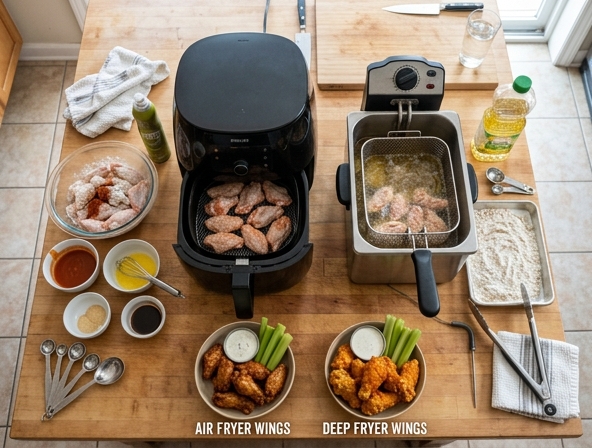
| Comparison Factor | Deep Fryer | Air Fryer |
|---|---|---|
| Core Mechanism | Immersion in hot oil for rapid dehydration and browning. | Convection-based hot air circulation. |
| Crispiness Level | Traditional benchmark; highly consistent texture. | Variable; relies heavily on surface moisture management. |
| Main Challenge | Requires oil management and cleanup. | Limited by appliance capacity and potential for sogginess. |
| Scientific Principle | Maillard reaction (Essential for color and flavor). | Maillard reaction (Essential for color and flavor). |
| Preparation Tip | Minimal prep needed for texture. | Requires careful moisture removal for optimal results. |
Air Fryer Vs. Deep Fryer For Buffalo Wings: Achieving The Ultimate Crispy Texture
The pursuit of the perfect Buffalo wing is a culinary obsession for many. At the heart of this obsession lies the quest for the "ultimate" texture: skin that shatters with a crisp crunch, revealing succulent, tender meat beneath, all tossed in a tangy, spicy, buttery sauce. While the ingredients for the sauce are simple, the cooking method is the subject of intense debate. Should you stick with the traditional deep fryer, or has the air fryer finally claimed the crown?
The Science Behind the Crunch
To understand the difference, we must first look at the science of frying. The secret to crispy skin is the Maillard reaction-a chemical reaction between amino acids and reducing sugars that gives browned food its distinctive flavor. When you introduce chicken skin to high heat, the moisture must be evaporated before the fat can render and the skin can crisp up. If the process is too slow, the chicken steams; if it is too fast or uneven, the exterior burns before the interior is cooked.
Deep Frying: The Time-Honored Gold Standard
Deep frying remains the benchmark against which all other wings are measured. By completely submerging the wing in hot oil (typically between 350°F and 375°F), you ensure that heat is transferred instantaneously and uniformly to every crevice of the wing.
The Pros:
- Uniformity: The surrounding fat ensures the entire surface area of the wing browns at the exact same rate.
- Texture: Deep-fried wings develop a "shatter-crisp" exterior that is difficult to replicate. The hot oil effectively flash-fries the skin, locking in moisture while rendering the fat completely.
- The "Double-Fry" Technique: Professional kitchens often fry wings twice-once at a lower temperature to cook the interior, and a second time at a higher temperature to achieve maximum crispness. This level of control is unique to deep frying.
The Cons:
- Cleanup: Dealing with quarts of hot, used oil is a logistical nightmare for the average home cook.
- Safety: Open vats of boiling oil pose significant fire and splash burn risks.
- Health: While the wings are delicious, they are inherently saturated with the cooking medium, significantly increasing the calorie count.
Air Frying: The Modern Challenger
The air fryer is essentially a high-powered, compact convection oven. It uses a heating element and a high-speed fan to circulate hot air rapidly around the food. In the context of wings, the air fryer is essentially "mimicking" the deep frying process using air instead of oil.
The Pros:
- Convenience: Minimal cleanup, no oil disposal, and quick preheating times make air frying an ideal weeknight solution.
- Health Profile: You achieve a crispy finish using a fraction of the oil, relying on the chicken's own rendered fat to do the work.
- Consistency: Once you find your preferred time and temperature, the air fryer produces predictable, repeatable results without the need to monitor oil temperatures.
The Cons:
- Capacity: Most air fryers have limited basket space. Overcrowding is the enemy of crispiness; if you stack the wings, they will steam rather than fry.
- The "Dryness" Factor: Because air fryers rely on circulating air, they can sometimes over-dry the meat if cooked for too long.
Bridging the Gap: Tips for the Ultimate Crispy Air-Fried Wing
If you choose the air fryer, you must compensate for the lack of submersion. Here is how to achieve deep-fry quality results:
- Dry the Skin: Moisture is the enemy. Use paper towels to pat the wings until they are bone-dry before seasoning.
- The Baking Powder Hack: Toss your wings in a small amount of baking powder (not baking soda) and salt. The baking powder changes the pH level of the skin, breaking down peptide bonds and allowing the skin to crisp up more effectively.
- The "Golden Ratio": Cook your wings at 400°F (200°C). Start with 20 minutes, shake the basket, and check every 5 minutes until they hit that dark golden-brown color you desire.
- Do Not Overcrowd: Air must be able to circulate *under* and *around* the wings. If you have a large batch, cook them in shifts.
The Verdict: Which Should You Choose?
If your priority is the authentic, bar-style experience-where the skin is almost glass-like and the fat is perfectly rendered-deep frying remains the superior method. It provides a level of indulgence and texture that physics simply favors over convection-based cooking.
However, for the practical, health-conscious home cook, the air fryer is a revelation. By utilizing the baking powder trick and managing your batches, you can achieve a "90% result" compared to deep frying, with 10% of the mess. For weekly cravings, the air fryer is the clear winner; for game-day celebrations or special occasions, the deep fryer is worth the extra effort.
Ultimately, the "ultimate" wing is the one that gets eaten. Whether you are adjusting your oil thermometer or dialing in your air fryer settings, remember: dry skin, high heat, and a generous toss in your favorite Buffalo sauce are the real keys to success.
Disclaimer:
The information provided on Eateryn is for general educational and informational purposes only and is not intended as medical, nutritional, or healthcare advice. It should not be used to diagnose, treat, cure, or prevent any disease or medical condition.
Always consult a qualified physician, registered dietitian, or other certified healthcare professional before making changes to your diet, exercise routine, or lifestyle, or regarding any medical questions or concerns you may have. Never disregard or delay seeking professional medical advice because of something you have read on this website.